From play money to personal stakes: The Pain-Based Assumptions Map
Stay up to date with the latest insights
My last article was part 1 of a 2-part series in which I share framework combinations that make assumption prioritisation more concrete. In that article, I shared one of my most favourite framework combinations that makes the debate "hoch much evidence is enough" more concrete: The combination of David Bland's Assumptions Mapping with Itamar Gilad's Confidence Meter.
It's particularly helpful when:
Your team is open to learning
People are looking for a structure to guide evaluation
You want to establish consistent standards across multiple sessions
This article is part 2 and describes combination 2 that is especially powerful in heated debates about the importance of an assumption: The pain-based Assumptions Map.
Combination 2: Using the Bet-Cost Matrix and physical pains to create personal stakes
Obviously the point is not about REAL physical pains. Don't go to your team members or your line manager and punch them in their face ;)
It's more metaphorical.
One of my observations in subjective debates about the importance of an assumption and evidence strength is that to many product team members the debate is very detached. It seems as if it’s not about them and their contribution to the product’s and the company’s success, but about "some sort of play money".
So I asked myself: How can I make the debate more personal? How can I make the team "feel" the importance of the debate? How would they behave differently when it was about THEIR money and THEIR pain?
This is how this combination 2 was born.
Let's again start with David Bland's Assumptions Map. It STILL has these two axes: Importance (vertical) and Evidence (horizontal).
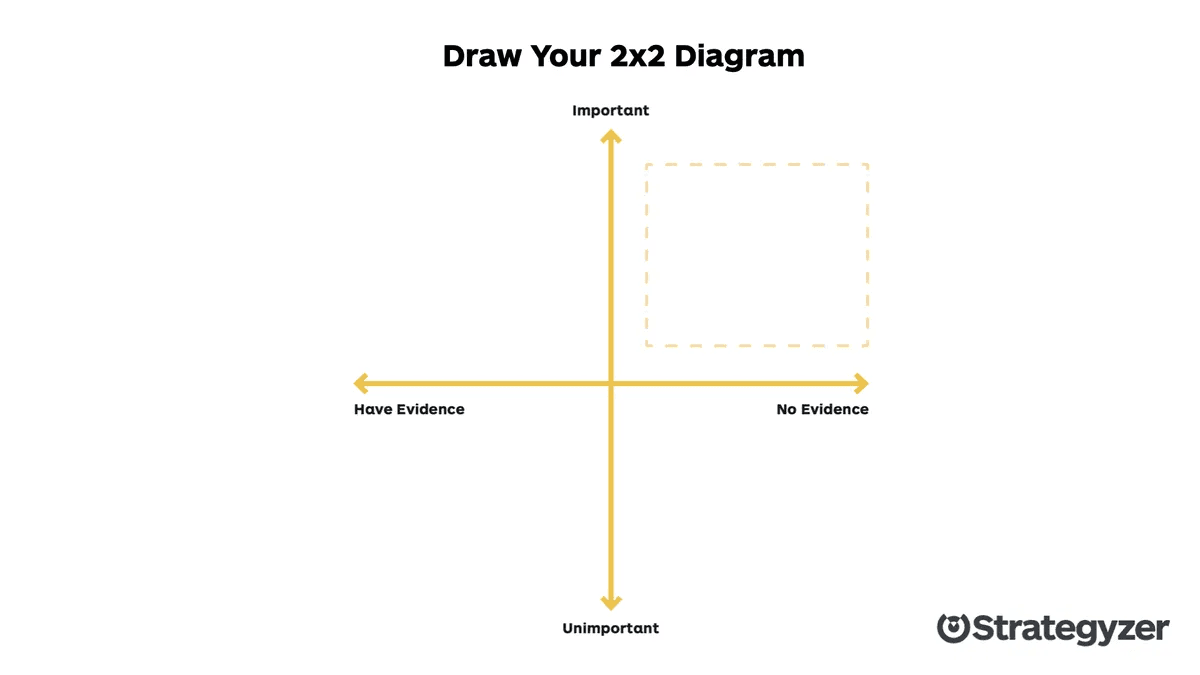
Now, here's where it gets fun.
On the horizontal axis, we blend it with Hias Wrba's Bet-Cost-Matrix. Here's the original article about the framework and here's the publication - they are in German but your favourite LLM should be able to translate it. If not, here's a short article in English that explains the gist of it.
Ingredient 1: The Bet-Cost-Matrix
This is how the Bet-Cost-Matrix looks like (these are the original images by Hias Wrba):

For each individual idea you ask these two questions in this order:
How much would it cost to build this?
What would you bet that this idea is going to be successful? (Hint: Define what success means first)
For each question you’ve got the same options. From lowest cost or risk to highest cost or risk:
My…
… house
… car
… pot of money
… vacation
… some scoops of ice cream
In case there are not so many people in the room who have a car or house or a lot of money, you can obviously swap the items that are more commonly owned in the room, or simply with x-months of salary. In rounds of senior managers, however, this is a pretty good scale.
The result defines what to do with the idea:
Build it.
Do more directional research.
Do more foundational research.
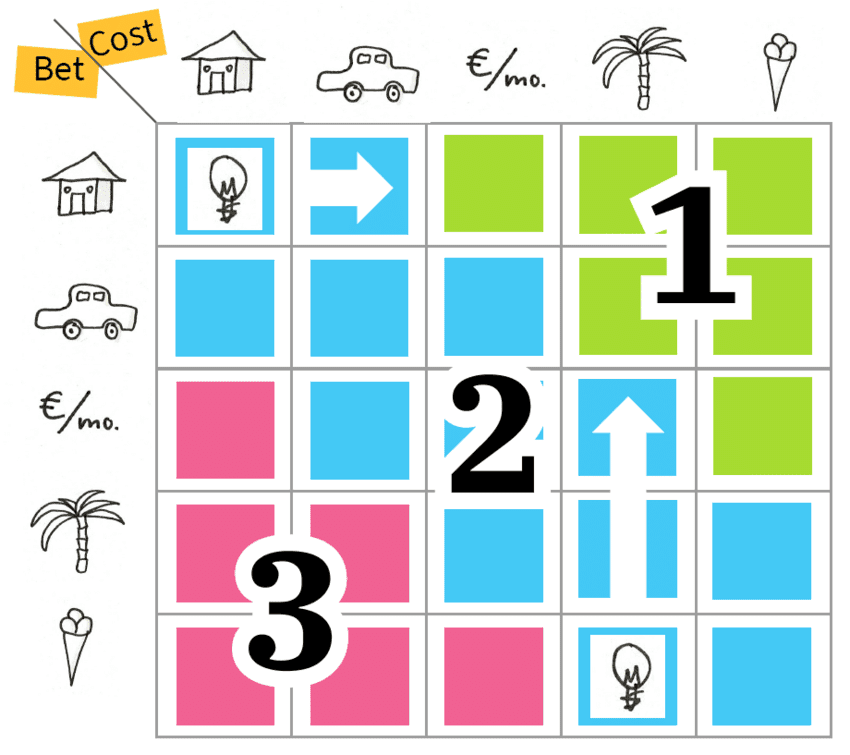
The magic of this question is that it creates more ownership when it's suddenly about their own investment, not the company's.
Ingredient 2: The Pain
Alright, let's now look at the vertical axis: The importance of an assumption.
The question that I ask to create more ownership in the debate whether an assumption is critical for the idea's success is: "If this assumption wrong, how much will it hurt the overall idea?"
And then, I give them the following scale:
It will…
break our neck ☠️
break our spine but we'll survive
break a leg which is painful but will heal in a couple of months, maybe with long-term damage
create heavy migraine
create a mild headache
create mild indigestion
make us a bit dizzy
leave small almost unnoticeable bruise - who cares, let's go dancing 💃🏻
You see, we inverse the question about importance by making failure create pain. And because "pain" can be abstract, we make it tangible with a scale that everybody can understand what it would do to the idea if the idea was their body.
The Blend
Let’s get back to the Assumptions Map and bake the ingredients into it.
Blend the horizontal axis with the Bet-Cost-Matrix and ask for physical pain for the vertical axis.
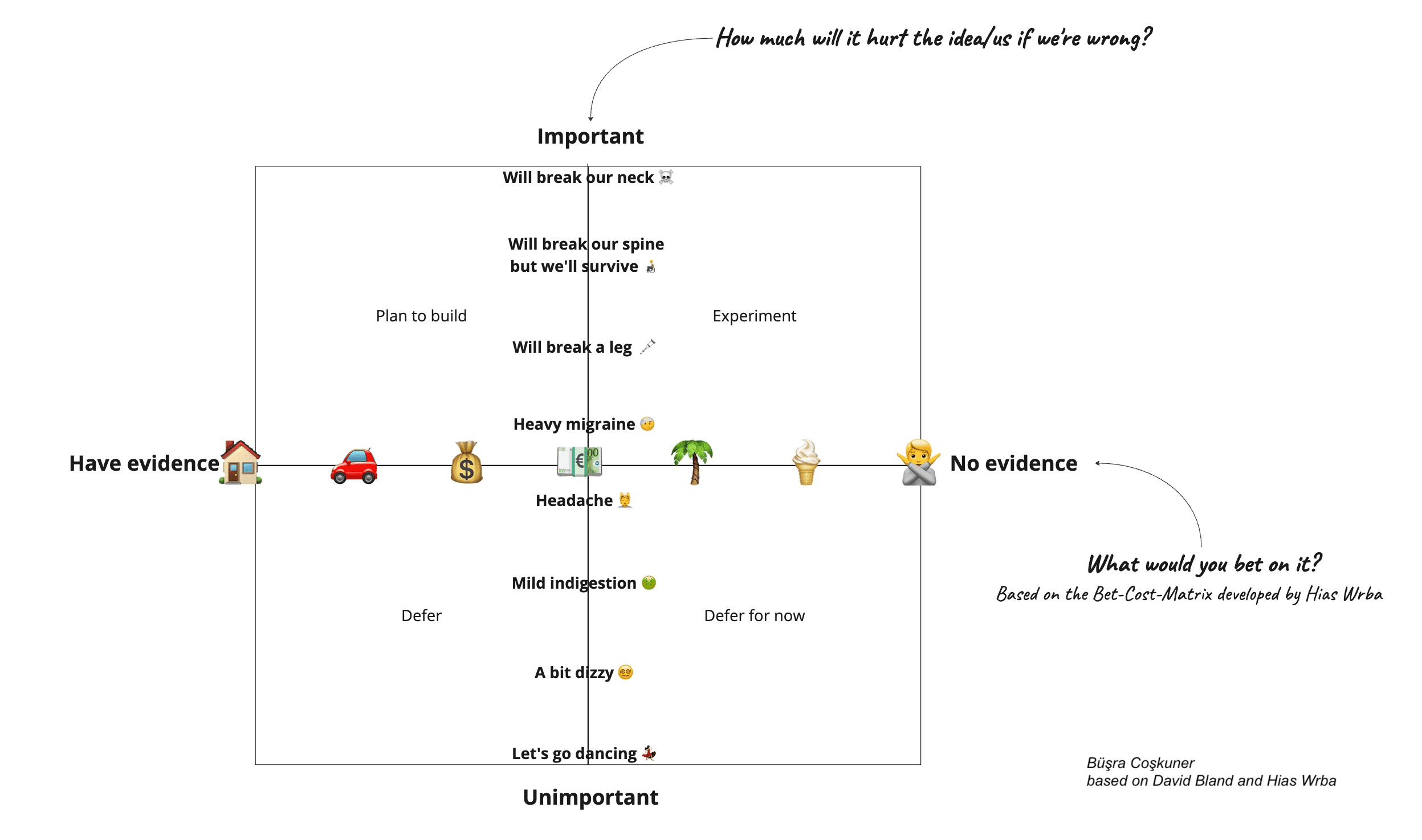
For each assumption, ask:
“What would you bet that this assumption is right?” → move the card from the highest bet (house) to the lowest until they say stop.
"If this assumption wrong, how much will it hurt?" → move the card from the highest pain (neck break) to the lowest until they say stop.
Now suddenly the stakes feel more real and those endless, subjective, detached debates turn into clear priorities.
The meaning of the quadrants stay the same. Q1 (upper right) are the most riskiest assumptions that need to be tested. Q4 (upper left) are proven important assumptions.
When to use this combination
Use this Pain-based Assumptions Map when:
Discussions have become stubborn or circular
You need to break through analysis paralysis quickly
People in the room are too detached and don't see the risk of being wrong
Team members need a wake-up call about the real-world impacts of their assumptions
How to use the pain-based approach without Assumptions Mapping
You can use the Bet-Cost-Matrix as a standalone framework, of course. Whenever someone is super sure about an idea, simply ask the questions:
How much does this idea cost? (horizontal)
What would you bet on this idea? (vertical)
and move the idea on the axes. It becomes some sort of an Impact-Effort matrix in which the confidence behind the impact becomes more tangible.
I first heard this approach from my friend Timothy Krechel and use this ever since.
Regarding the importance of an assumption and the metaphorical physical pain it would create in case it was wrong, you can ask this for any assumption that you derive in any conversation. As I mentioned in my last article, in debates I like to ask the question whether it is a known, presumption or assumption. As soon as you agree that it's an assumption, you can ask how much pain it would create if your assumption was wrong. If it turns out to be just a mild headache - well, why spend another 10 minutes on this debate? Stop it there and discuss more important topics.
Take action
Now, pick your next big idea and map it out in the pain-based Assumptions Map and observe if and how the quality of your debates change.
Happy mapping (and may all your assumptions be painless).
Product management insights, delivered to your inbox
Sign up for weekly product insights. No spam.