How to use Impact Mapping to align a product team’s work with strategy - and see why they are stuck
Stay up to date with the latest insights
If you are a close follower of my work, you'll know that I'm a fan of Impact Mapping - and if not, now you know that I am 😄
I shared a lot about Impact Mapping in the past, both on LinkedIn and on my blog here and here. And you might have heard about Impact Mapping from different other practitioners like my friend Tim Herbig, Spencer Turner, Marc Dalgarno or Christoph Steinlehner.
Most product people know it as a product discovery technique that links business goals to solutions in a structured way. It helps answer questions like who you’re targeting, what outcomes you want, and how you’ll achieve them.
But what if I told you Impact Mapping is more than just a discovery tool?
Today I’m here to show you how Impact Mapping can serve other purposes: How you can use it to bring your teams together around shared product goals and align their work with the overall strategic business context. And even surface why a product team doesn't deliver against business goals despite using OKRs and despite delivering and being busy.
That’s the origins of Impact Mapping: A visual aid to align the daily work with strategic objectives. If you want to learn more about it, you can check its official website impactmapping.org, run by Gojko Adzic who made the method popular (he doesn't like me to say that he invented it but to me he invented it - don't tell him that I said that 🤫)
If you’re a leader struggling to create alignment within your teams, Impact Mapping might be just what you’re looking for. In my workshops, I use it to ensure everyone is working on ideas that drive real customer value and contribute to broader business objectives.
In this article, I’ll share 3 real-world examples of the effects of using Impact Mapping for alignment from strategy to execution, for truly effective product discovery and delivery.
I’ll show you how Impact Mapping helps teams move beyond discovery and aligns them across strategic goals, product outcomes, and user needs.
Ready to dive in?
How an Impact Map for Alignment Looks Like
This is what a traditional Impact Map looks like:
It starts by defining the Goal - the main business objective
It identifies Actors - key user segments, or stakeholders, who play a role in achieving that Goal
For each Actor, it defines the Impact - the desired change in behavior
It lists the Deliverables - the specific solutions or features that will drive the Impact
Here is an example by Gojko Adzic (you can find more examples on the website impactmapping.org):
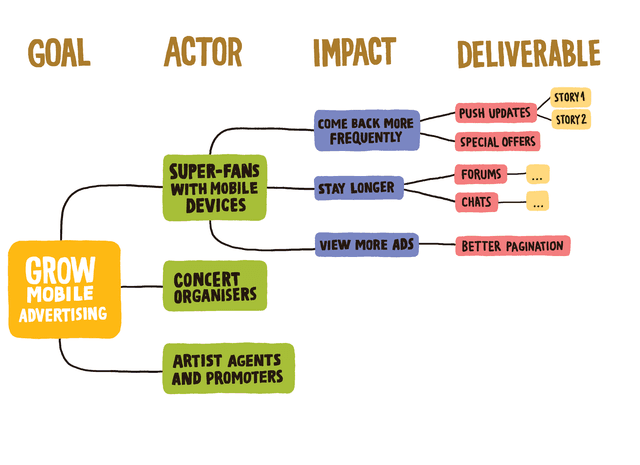
Source: impactmapping.org
Here is an anonymised example from a team that I worked with that wanted to find solutions that would increase activation rate by simplifying the onboarding experience:
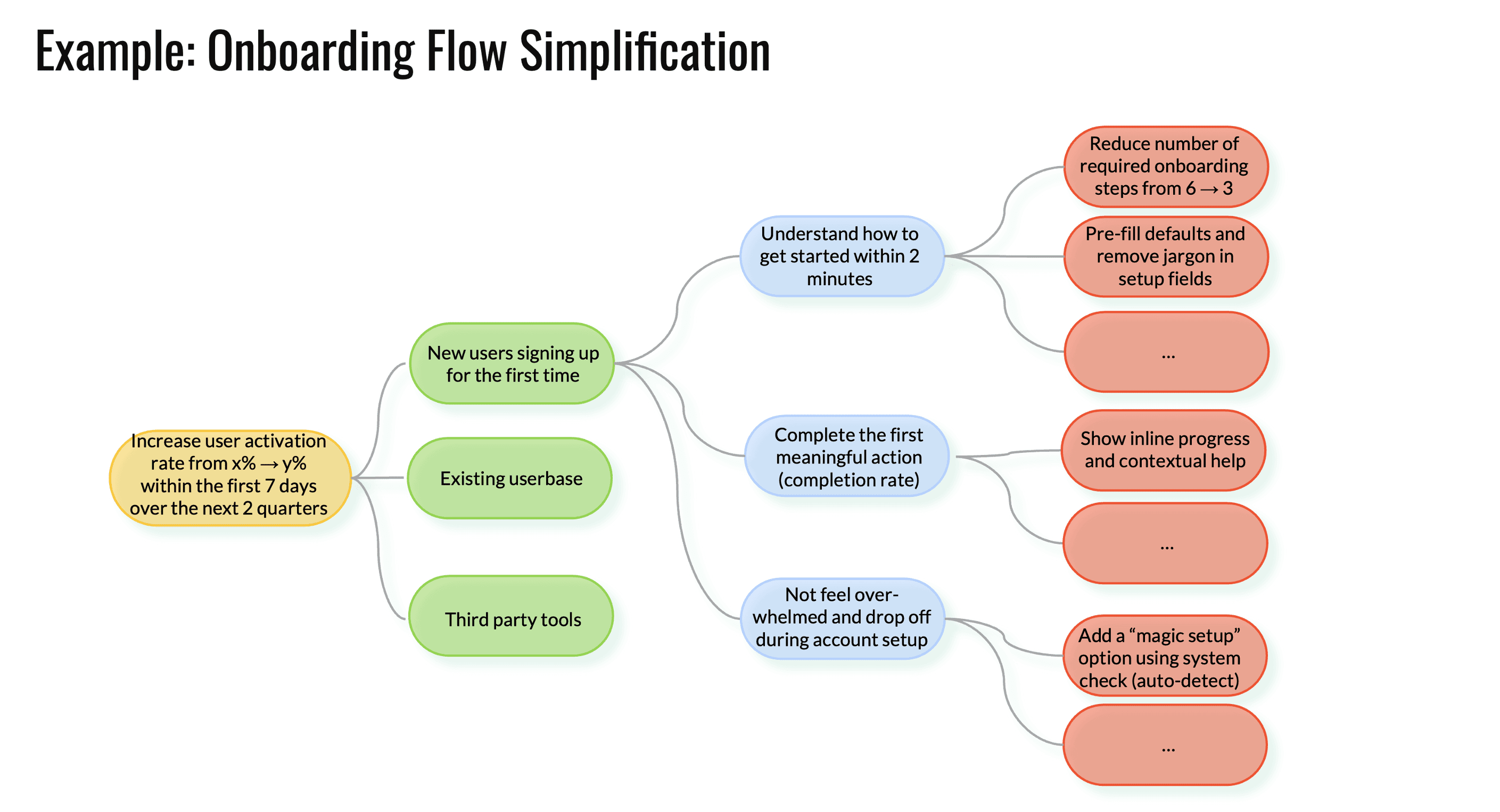
Source: Büşra Coşkuner
But I like to do things differently.
In my workshops, I use an adapted version of Impact Mapping that uses words that we know better in our product management bubble. And I tweak the structure to connect each step with the company’s real strategic goals, address their actual challenges and incorporate their individual ways of working, so every action serves a clear purpose.
Here’s how I break it down using more product management’sy terminology:
Goal: This remains the central business objective. But I avoid the term “Impact” here to prevent confusion, as the word “Impact” in “Impact Mapping” refers to what I call “Outcome” in my adjusted version - not the Business Goal.
If I renamed “Goal” to “Impact”, the focus of the exercise would shift from the resulting “outcome map” to the business goal, missing out on the real value of this technique.Actor: I keep the traditional concept of Actors, but emphasize that, especially in B2B, Actors have their own business objectives when using the product. I like to ask teams to identify these as part of the exercise. It encourages them to see Actors not only as end-users but as partners with specific goals and needs.
Outcome (instead of “Impact”): Traditionally, Impact is about the change we want from each Actor. I use Outcome instead because it shifts focus to what we actually want to achieve for the Actor. This keeps the focus on the Actor’s desired results rather than on the company’s objectives. I like to remind teams that the outcome is about creating real, observable change for the Actor, not just hitting KPIs. Although teams can also have company-relevant outcomes. I encourage them to look for the win-win: “How can we achieve a business-driven outcome through addressing an Actor-driven outcome?
Solution or Output (instead of “Deliverable”): This term shows that the purpose is to deliver something meaningful, not only to complete a task. Sometimes this can mean an experiment or a test, and other times, it might lead to a concrete product feature. And sometimes, it can be something even simpler that doesn’t even require the team to build anything, instead, for example, just adding copy, changing an internal process, or creating a sales document.
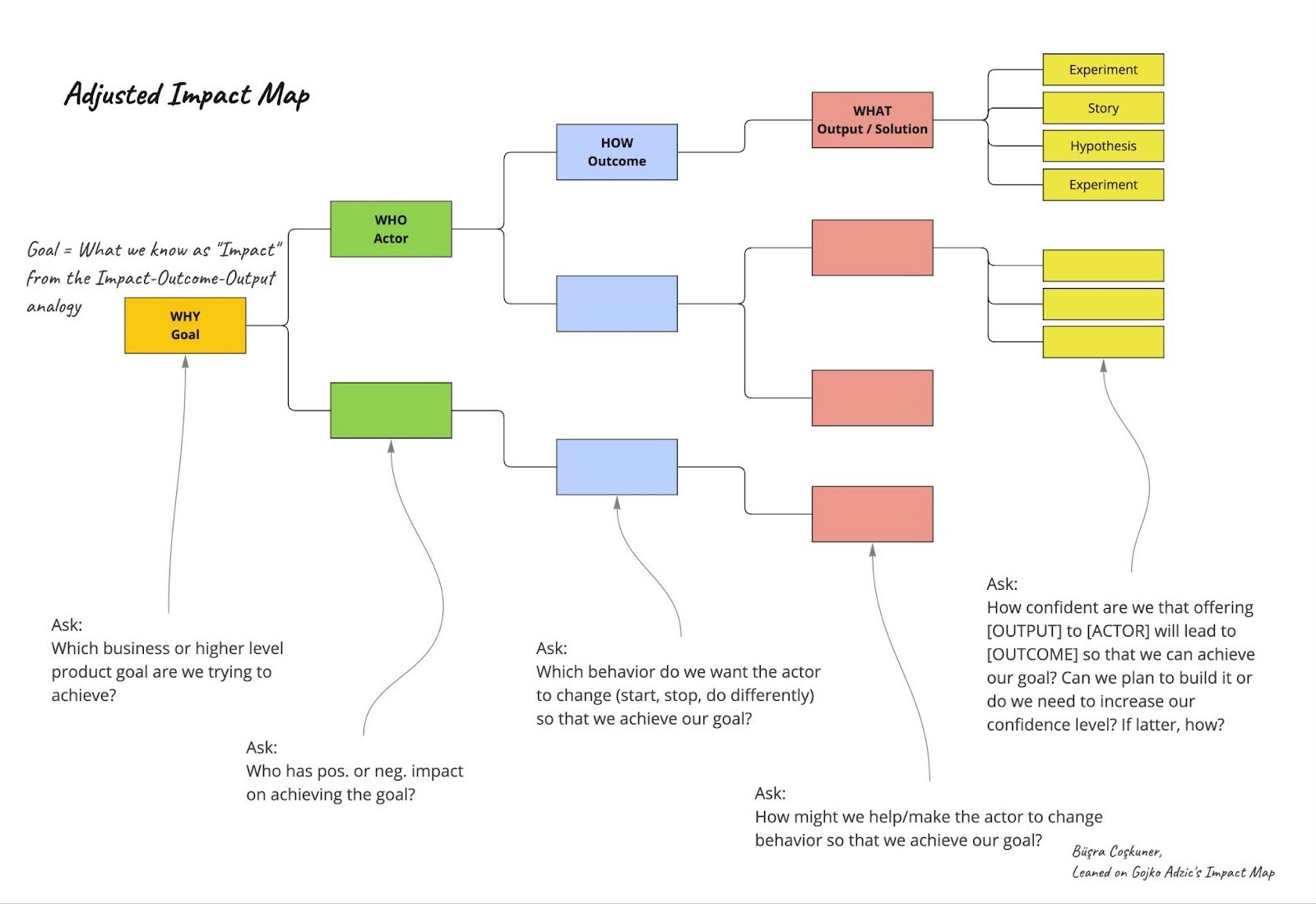
Source: Büşra Coşkuner
How I Helped 3 Teams Achieve Different Results With Impact Mapping
In my Product Discovery workshop, in which I combine Impact Mapping with Assumption Mapping and hypothesis-based experimentation, every team has different “aha” moments.
Some struggle to align on goals, others have trouble defining their audience. But each team ultimately finds the clarity they need.
This is only possible because I don’t stick to the original framework but adapt their thinking to each company’s, even each team’s setup, internal practices, and level of product discovery knowledge.
Here are three real-life examples:
Team 1: From Struggling with OKRs to Realising Their Value Proposition
Picture this: your team suddenly realises their OKRs are totally disconnected from the company strategy! That’s exactly what happened with this team. What seemed like a terrible realisation, was actually a helpful moment. Understanding where OKRs came from helped the team find the answers to big questions that were blocking them.
Actors play a central role in any product you build, but nobody in the team was thinking about them. Impact Mapping forced them to do it. The natural consequence is twofold: a deeper conscience about the people they were trying to influence, and the realisation that their internal team priorities don’t match with the most important Actors they need to serve to achieve their overarching business goals.
“What is your product’s value proposition?” - The team could not answer this simple question. Naturally, any product discovery they did fell short. This was an enablement team, so the “aha” moment came when they realised the team itself was a product. So the value proposition was about the team as well. Once this was defined, the OKRs they should be working towards felt a lot more in place.
This is the workshop structure I had prepared for this team:
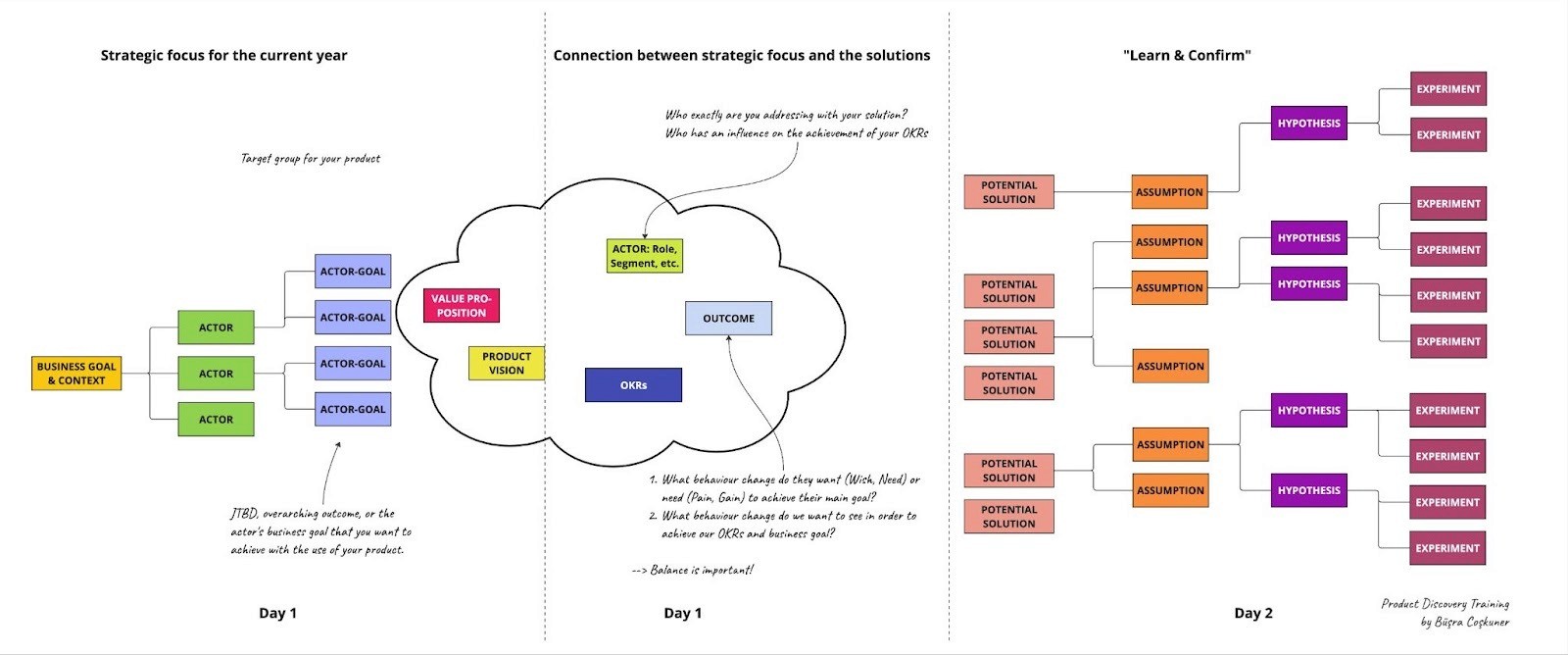
As you can see, in my preparation I had already noticed that there is something unclear in the connection between Value Proposition, OKRs, and the overarching strategic focus.
Team 2: From Confusion on the Actors to Involving Tech More Often
This team had an underlying confusion between the roles of user and customer. So nothing they tried ever seemed good enough. Through Impact Mapping, the team clarified who the true Actors and their desired Outcomes were. Realising there were multiple target groups helped the team let go of the idea that every solution needed to fit all users. In addition to that, they even noticed that they needed to further segment their target groups to make better decisions. In a B2B, and even more in a B2B2C environment, it is crucial to differentiate the roles well in your discussions and be precise in the segmentation as well.
The second “aha” moment happened when they realised they were not involving tech enough, and how much interdependencies there are between their team and other teams. So, in the Actors discussion two things happened:
1) Nobody mentioned internal roles, like Compliance or Security, nor did they discuss technical aspects of product development throughout the workshop.
2) They mentioned many other teams, and only then noticed that they NEED the help of those teams to be successful themselves.
They concluded that Impact Mapping showed them the interconnectedness of their work and the urgent need for cross-team collaboration, as well as getting the technical voice involved deeper in the decision-making.They came to a final, common realisation: they needed to question the assumptions driving their ideas to understand the success factors. Otherwise, regardless of the discovery method they picked, it would fail. But that’s a topic for another article!
Team 3: From Blurred Lines to Grounded Decisions
Like many teams, they fell into the trap of mixing up different levels of context, jumping between strategy, tactics, and details all in the same conversation. Impact Mapping helped them separate the discussions and make decisions without getting tangled up in different layers.
This team operates in the B2B and B2B2C spaces, dealing with many different target groups. They’d always known this, but the structured Actor exercise in Impact Mapping made them realise that they also need to consider internal stakeholders of their customers to land their product. This realisation uncovered a major risky assumption they'd been making: they were prioritising desirability and viability, but for their product getting their customer’s Compliance approval was often a bigger obstacle, which is a feasibility risk.
Finally, the team came to an “aha” moment when they realised how much they were basing decisions on assumptions rather than facts, simply by asking themselves: "Is this a known, a presumption, or an assumption?"
- I define a known as something that is a fact by nature's or market’s laws or something that we have lots of strong evidence for.
- A presumption is something that we take as a fact (even though it's not) because we have lots of indication or some strong evidence of its truth. But increasing the confidence even further would be too costly or impossible.
- An assumption is anything that we guess or think that we don't have any evidence for, or only some light indication.
By asking this simple question, it turned out that so many things they thought were “known truths” turned out to be ideas they’d just heard from others. By questioning this, they were able to make more evidence-based decisions.
This is the workshop structure I used for teams 2 and 3.
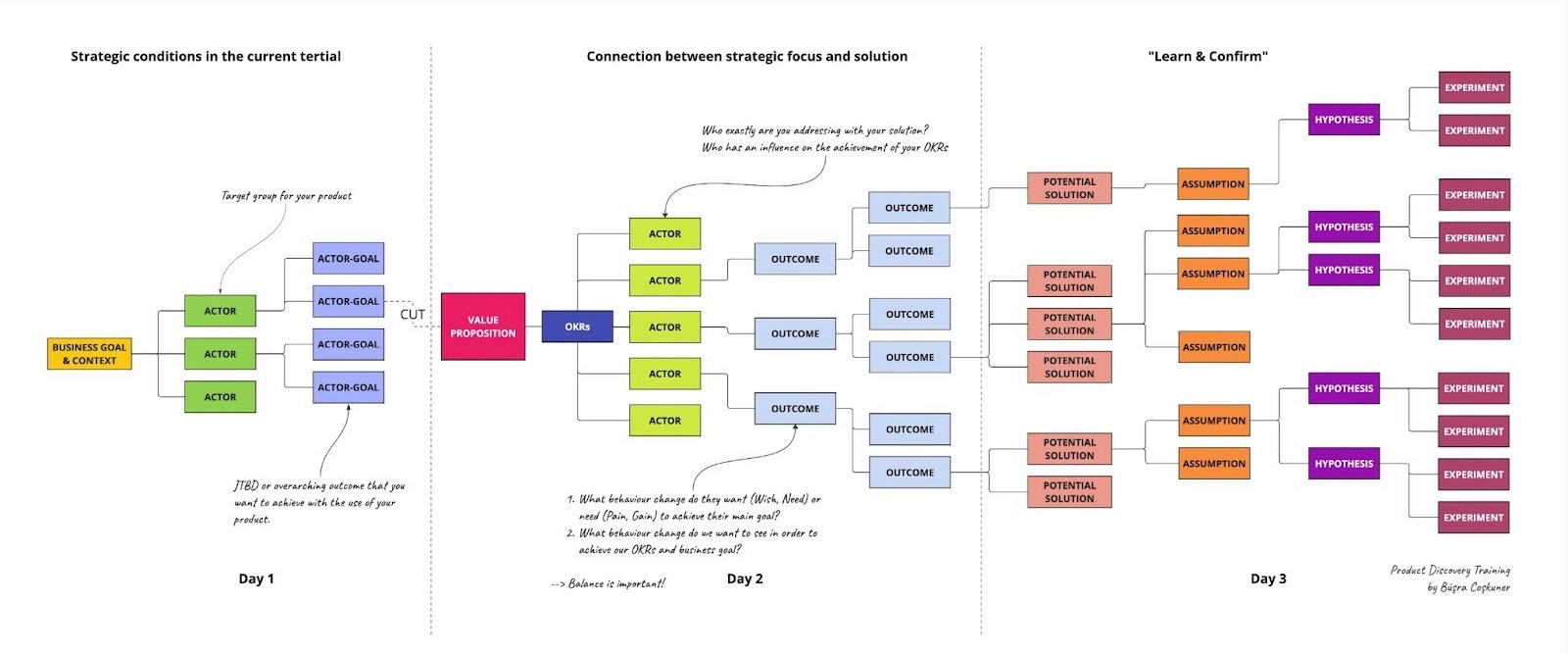
We made the whole end-to-end connection between the year’s strategic context (the first column) and the teams' daily activities. I call this the AIM model, btw. which stands for Align - Identify - Measure. There's more to AIM but that's also for another article.
Plus, we used the product’s vision and value proposition as guiding principles and selected 1 OKR as the representation of the “business goal” that guided the rest of the Impact Mapping activity.
Take Action Today: Start Using Impact Mapping for Alignment
Here’s how you can apply Impact Mapping with your team right away:
Set a SMART Goal: Start by defining the main business goal you’re trying to achieve in a specific time horizon between 3 to 6 months into the future.
Identify Your Actors: With the help of your team, list all Actors that can help or hinder your team in achieving the business goal, and those who you actively serve. Don’t forget internal stakeholders like Compliance, Security, or other Product teams, in case they play a role.
Define Outcomes: For each Actor, describe what they want to achieve. You can blend them with specific changes in behaviour or desired results. Now the most important point: find the Win-Win! Which observable Outcomes create value for the Actor in such a big way that they will help you achieve your business goal? Pick your top 1-3 high-level outcome-bets.
Map Solutions: Brainstorm solutions or outputs that have the power to drive these 1-3 Outcomes. Alternatively, map solutions that you’re keeping somewhere in an ideas list against the Outcomes. Remember that, sometimes, the right solution is simply a small tweak, like adding new copy or adjusting an internal process.
Call Out Assumptions: Review the map and question your team’s assumptions. Which parts are based on knowns, presumptions, or assumptions?
By taking these steps, you can create an actionable Impact Map that aligns your team’s efforts with strategic business goals. Try it in your next team meeting and share the results with us, if you’d like.
Conclusion
Impact Mapping goes beyond typical discovery frameworks.
It’s a way to uncover the real insights your team needs to move forward. It invites the teams to identify and focus on relevant Actors in a structured way which is what most teams get out of sight. It’s also flexible enough to blend it with other frameworks, making it work in your specific context.
I’ve seen how it sparks “aha” moments that align teams with the bigger company goals, regardless of the challenges they’re facing. If you want your team to focus on the right activities that drive business results by addressing key audience needs, Impact Mapping is the way to go.
Does alignment feel out of reach in your teams? Let's change that. Get in touch and we'll make Impact Mapping work for you!
—
This article was edited by Diana Bernardo.
Product management insights, delivered to your inbox
Sign up for weekly product insights. No spam.