Why “Just focus on outcomes” doesn’t apply to client work (and what to do about it)
Stay up to date with the latest insights
Remember when I asked you to send me your questions, promising I’d answer them?
A reader did just that (thank you!). She asked two questions, but they’re about different topics, so today I’ll answer only the first one. Keep an eye out for the upcoming issues, I’ll answer the second one soon.
This was her question:
"As service providers, we tend to have the challenge that we do not get full transparency about overarching goals, which makes it hard to find the right metrics. Often projects are scoped together, and the goal is just to get that scope done (e.g. a software system needs to be replaced). There is not much room for real outcome or optimisation.”
I know exactly what you're talking about and how demoralising it can be. At one point in my career, I was working for an agency, and I was the first point of contact with our clients. I lived this exact challenge.
Here's what I've learned about navigating it.
First: understand the cultural setup you're in
There are two levels to your relationship with a client: the cultural and the personal one.
On the cultural level, ask yourself: does this client see you as a shipping machine, or as an extended arm of their team? If the culture is simply "ship the scope," unfortunately there isn’t much you can do (but there is something! Keep reading). In a case like this, your “metric” is: did you ship it or not? Forcing outcome conversations in such an environment will likely lead to friction and affect trust.
But if the culture is more collaborative, then there's an opening.
Second: check the personal relationship
Even if the cultural setup isn't ideal, sometimes the relationship between you and your contact at the client side is close enough to change how you work together. A trusted relationship creates the space for a different kind of conversation.
Third: move the conversation from output to outcome
If there's openness on either level, here's how to start:
Run a "customer interview" with your client the same way you'd interview a user to understand their needs. Never, ever ask "which problem are you trying to solve?" Instead, ask open-ended questions that get at the benefit they're seeking. Try questions like these:
When can we call this a success?
What effect are you trying to create?
What would tell you we've shipped a good solution?
They'll probably answer with features or functionality at first. That's fine. But take it one step further: "Okay, and which effect does that create?" Slowly, move the conversation into the benefits space. You're not trying to own the metrics. You're simply helping your client think in outcomes and positioning yourself as a thinking partner.
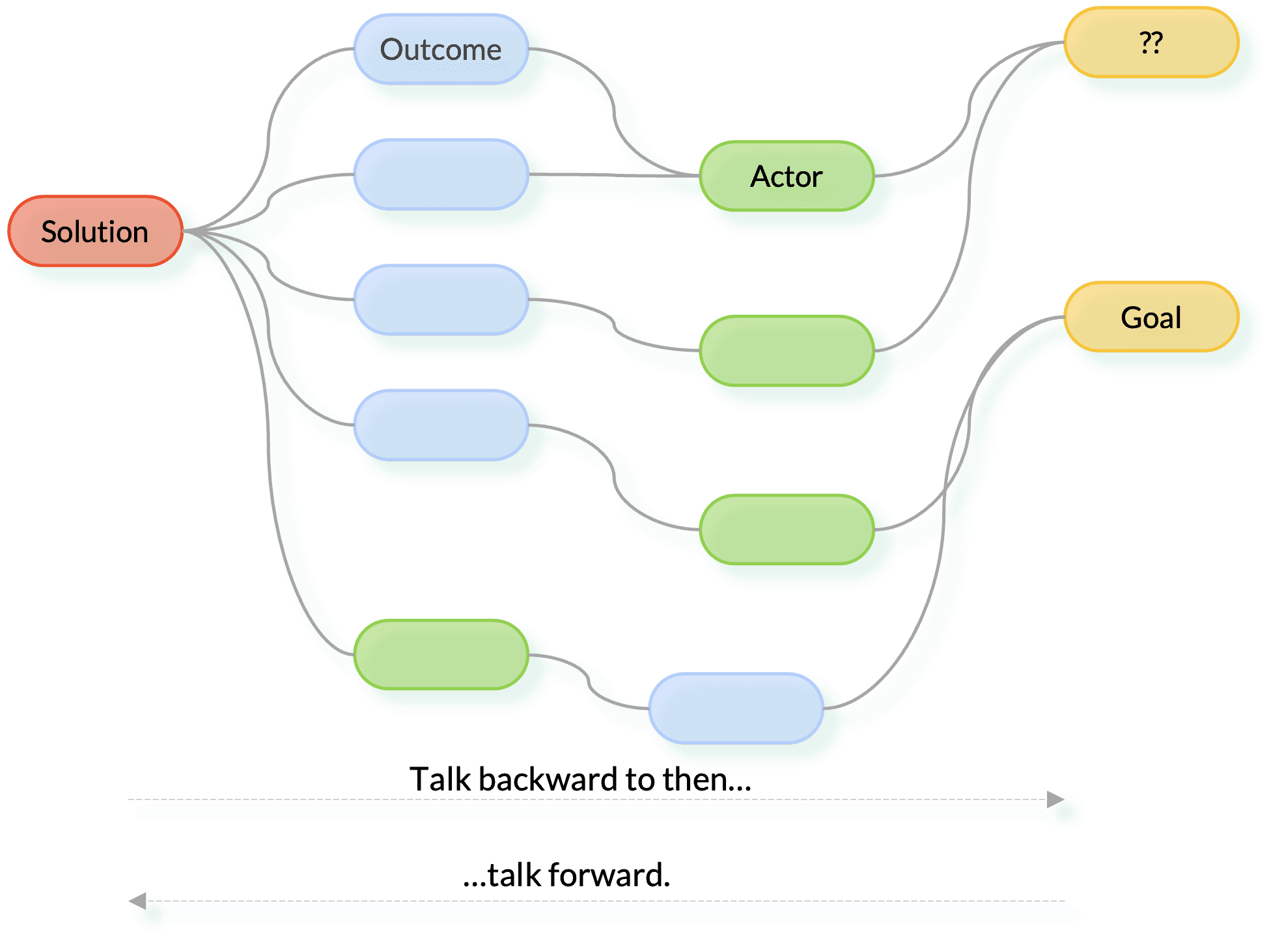
Reverse Impact Mapping by Büşra Coşkuner
It's easier to understand this if you think about Reverse Impact Mapping. Start from the solution your client handed you and work backwards through the actors it affects and the outcomes it creates, until you reach the actual goal. Once you have that, you can talk forward again: making decisions that are grounded in outcomes, not just scope. If you want to go deeper on this, I wrote about it here.
After some consistent conversations like this, your client likely stops seeing you as a vendor executing a brief and starts seeing you as a partner who’s there to help them reach their goals.
One important detail to remember: your goal is to design the metrics together with your client, but let them own them. You shouldn’t be the one accountable for hitting those numbers. Your management surely doesn't want revenue at risk from things outside your control, and rightly so.
What you can do instead is use those metrics internally to inform your decisions and keep the relationship trustful. Think of it this way: your client owns the destination, you're helping them on the way there.
The longer your team has worked with their product, the better you can do this. Your engineers will start contributing ideas about which solutions to actually build, not just executing what they're told. That's a sign the relationship has stopped being purely transactional.
A word of caution
Even if you make progress at the relationship level, your client still has their own bosses. And their bosses have strategies they may not be allowed to share with you.
I experienced this at the agency. We had a client with an online shop that was buried in technical debt. We built a solid case for a full rewrite, but they declined. Little did we know they had already decided to shut the shop down entirely.
Accept that some things are simply outside your control.
So, is it worth trying?
Of course, always give it a shot. Try to shift the culture where you can. Build the relationship when you have the chance. Move the conversation toward outcomes when there's an opening.
But don't measure your success by whether it worked or not. Sometimes it won't, and that's not on you.
Some clients will resist every step of this. Others will surprise you. You can't know which is which until you try.
Product management insights, delivered to your inbox
Sign up for weekly product insights. No spam.