Discovery is the new bottleneck - When engineers move faster than PMs can think
Stay up to date with the latest insights
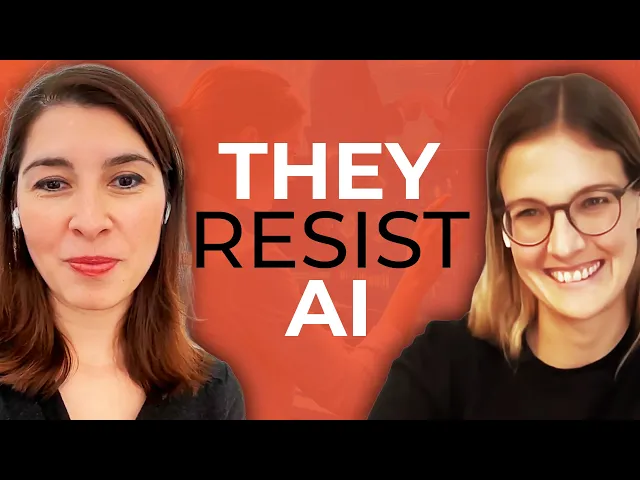
This article is an in-depth summary (I know, ironic) of an interview with Julia Bastian, Product Lead - Innovation & GenAI at Alasco. You can watch the full interview on YouTube.
Enjoy, and as always: Reach out with your thoughts, questions, comments.
—
In 2022, Alasco's Product Lead Julia Bastian and her team had a working AI feature in front of customers within two weeks of ChatGPT launching. This tells you something about Julia: she’s been focusing on AI for longer than most people, and she’s great at it.
At the time of the interview, she was splitting her time between leading AI adoption at Alasco internally and consulting other tech companies on doing the same. Which means she has something rare: a lived, inside view of a company's journey, and pattern recognition from seeing many others.
Alasco is a PropTech company based in Munich, building financial controlling software for the construction industry. Around 90 people, including 3 product teams, each with a PM, a designer, and 3-6 engineers.
AI adoption is well underway at Alasco, but unevenly so. One product team is standing out, with the other two being slower. The story of why and what the leading team has changed is part of what makes Julia's story so worth reading.
Change Started at The Organisation Level
The first AI feature, launched in late 2022, addressed a painful step in construction finance: checking incoming invoices against the terms of a construction contract to verify that amounts, line items, and conditions matched up. Exactly the kind of repetitive, rules-based task that AI seems built for.
The result was somewhat promising: it worked in about 85% of cases. But in a high-stakes environment, 85% was not enough to get customers excited, so the team abandoned it. Eventually, with more advanced models, they made it work. But it just wasn’t possible with the models from 2022.
However, this experience made one thing clear: they needed to take the whole organization on this journey. From HR, to GTM, to Product. So they started an organisation-wide enablement around AI in 2023, which they continue doing every couple of months.
Julia spends time helping people across the whole company understand how LLMs work, where they're useful, and how to use them day-to-day. They also realised they needed new roles, namely a GTM engineer, someone whose entire job was finding processes to automate and build them.
An example: they connected incoming tickets to a vector database of historical tickets and their answers, using an LLM to draft replies. Then, customer success reviews them and, in about 85% of the time, sends out the original response drafted by AI. That has saved about 20 hours per week.
This first phase of AI adoption happened across the org, in customer success, sales, and operations. It was only about a year ago that product and engineering really felt the change and realized their ways of working needed to change because of AI.
How They’ve Overcome The Initial Resistance
Julia told me a story I’ve heard in other conversations, too: AI adoption came with a set of challenges that have nothing to do with technical capability, but with identity struggles.
Engineers, in particular, feel AI threatens their professional identity. Alasco’s team is fairly young, with an average age of 32. But they still place their self-esteem in what they do. "And now there are people ten times faster than them with AI" Julia pointed out. For her, this has been the first time she's seen real tension in what had always been a smooth engineering organisation.
Alasco had to do something to help people overcome these struggles, and they landed on:
Running hackathons every two months, where teams build something with AI
Running enablement sessions to teach how LLMs work, what tools exist, and how to get good output. These were paired with sharing rounds, where people who have shipped something share their experience.
The leadership team has been sitting with engineers to talk about how they feel regarding all this. "It's more than just technically adapting AI. It's about the feelings behind all of that.”
Despite the effort at the organisational level, the results have been different across teams.
One product team has adopted AI significantly more than the others. Not by chance… They’re the ones tasked with building Alasco's first AI features. AI adoption became a consequence of the nature of the work. Building AI products required them to understand AI tools from the inside, and that understanding spilled into how they coded, prototyped, and collaborated.
How the AI-Powered Team Works Now
So what does this team's day-to-day look like now?
It still starts with a three-day design sprint where the trio (PM, designer, engineers) dives into the problem together. They do customer interviews, build a shared understanding, and create rough concepts. The PM defines the goal and the metrics. But from there, the old handover model, where the PM specifies, the designer mocks up, and engineering builds, no longer applies.
Product managers vibecode prototypes in v3 and Claude. This helps test ideas with customers while also creating clarity and alignment within the teams. Engineering got way closer to product discovery: now they attend customer workshops to understand processes in detail. Because many processes they build need customer data, and they can only test them in live scenarios with customers, this has also led to feasible prototypes that are going live really early in the process. Normally, they would have tested this for a long time before involving engineering.
In this new setup, designers are barely involved. At most, they jump in after the build, not before, to refine what has already been created by the engineers.
Finally, the role of the PM has changed significantly, too. The PM on this team doesn’t write any specs anymore. Instead, she spends her time running customer interviews, setting hypotheses, coordinating testing, and reviewing outputs. "The real product work”, says Julia.
The main challenge for the PM is keeping up. Engineers move so fast that the output requiring review is too much to handle. Julia mentioned that an engineer worked over the Christmas break and built an entire feature. When the PM came back, it was a lot to absorb. “She would even be happy to have fewer engineers, just to slow things down a little," Julia joked. Delivery is not the bottleneck anymore, discovery is.
This pace made Scrum outdated and irrelevant. Two-week sprints are too long when the team learns something new every two days. They moved to Kanban with a check-in every two days instead.
Building Features With AI ≠ Building AI Features
Julia made a distinction during our conversation that I think needs to be mentioned.
There are two different ways a product company can use AI: using AI internally to make processes more efficient, and building AI features that solve customer and user problems. The second is something many product managers are not really aware of yet. Building AI products and features needs a different approach. In 2025, they built a conversational agent that let users ask questions about their construction data, such as which projects were over budget or which contracts needed attention. Two weeks in, they had a working prototype live with five customers.
"Getting 80% of the cases right is really, really fast," Julia said. "But getting the output better in those final 20%, that's where the magic lies.”
AI features are non-deterministic. You put something in, and you don't know exactly what comes out. Improving the output doesn't require changing a UI element, like in traditional SaaS tools. It means adjusting system prompts, modifying tool calls, reworking the context, and then observing whether things actually improved or simply changed sideways.
As a consequence, the PM role at Alasco became more centred on evaluation and observability. Alasco uses langfuse to trace every step between a user's question and the model's answer, making it possible to see where things broke down and run structured evaluations each time something changed.
One thing that they have learned while building this agent is that it helps to have a small scope in the beginning and then incrementally widen the scope of the agent. At first, they built the agent for the entire product at once. Outputs were 80% good, but once they started tweaking things, the output for one question type improved while making others worse. They fixed it by narrowing the scope. For a period, users could only ask about budgets. They improved that one domain, then added another. "Start with a controllable scope," Julia said. “In a non-deterministic system, that's the only way to make real progress.”
The New Bottlenecks
This new way of working has produced two main bottlenecks:
Outsourcing your gut feeling
For PMs, outsourcing synthesis entirely to AI means losing contact with the actual conversations and with that, the gut feeling that comes from being present in them. A customer might say one thing in minute three and the opposite in minute eighteen. What will AI do with that? Produce something coherent that will erase the ambiguity entirely. A PM would catch the contradiction - that’s the job, after all. "The real insights still need to be found by a product manager”, Julia believes.
Merging roles
The Product trio is changing. Product managers and designers become more technical. Engineers are more involved in discovery. Julia doesn’t have a final answer on what this setup will look like exactly in the future, but she believes the traditional setup will definitely change.
Julia's Advice
I closed our conversation by asking Julia the same question I’ve been asking everyone I speak with in this series: “Imagine you're an advisor to a friend, and they want to adopt AI. What would you tell them to do, or be cautious about?”
Julia gave a three-part answer:
Start with enablement. Help people understand how LLMs actually work, how to use them practically, and how to identify which processes are worth automating. Share practical knowledge that people can act on the next day.
Then build a small team with the technical capability to automate processes. At Alasco, this was the go-to-market engineer. In other organisations, it might be someone sitting in operations or IT. Someone needs to own finding the processes and making them work.
Finally, for product people specifically, Julia had two things to say: first, use AI in discovery without losing your own thinking. AI works best as a companion through the process, not a replacement for it. Second, learn to build AI features. Many people are scared of doing it because they imagine it as something much more complex than it actually is. But the only way to learn is to try it yourself and be curious. Vibecode, build agents, and build your first AI features with engineering - even if this is not the greatest customer value in the beginning. It is a lot about learning.
What I'm Taking Away
Julia expects Alasco to be able to do more with fewer people in the future. Fewer engineers per PM, one designer shared across multiple teams, and a smaller customer support function. Not through layoffs, but by not re-hiring for the roles left vacant by people leaving.
We see the first reports that show that with AI people are working more than before, not less. This is the case when AI accelerates your output because it helps you do your job faster. Still, with AI entirely taking up some of the work from our plate, some people will end up with a little extra time on their hands. My view (Julia agrees) is that this is an opportunity most companies will waste. Those who keep their people and give them space to think will generate more innovation than those who cut headcount or expect extremely more output in the same amount of time (and burn their people out).
Imagine the customer support people who spent years reading every ticket but never had time for anything else other than responding to them. Pair their unique view of customers with some time to think, and they might reach the next unlock for the company.
You’ve probably seen this story elsewhere already, but I think it’s the perfect illustration of this: when IKEA’s AI chatbot took over nearly half of all first-level customer queries, they didn't cut the 8,500 people whose jobs changed. Instead, they retrained them as interior design consultants. That new service channel generated €1.3 billion in revenue.
Or read up on last week’s episode with Dominique Jost, Doist’s Head of Product, who shares how Doist enabled their customer support to meet customer demand through AI.
AI makes everything faster. But the biggest lever might not be the speed itself. It's the thinking time that comes with it, that most companies have been too busy to protect. Growing with your people will eventually make you stronger than growing against your people.
—
This article was edited by Diana Bernardo.
The video was edited by Connor Clayton's team at Precision Edits.
Product management insights, delivered to your inbox
Sign up for weekly product insights. No spam.