The Makers Manifesto is here. Here's why I have contributed to it.
Stay up to date with the latest insights
There are moments when staying quiet feels like the safer option. You watch things shift around you, you have opinions, but you tell yourself it's not your place to make a big declaration. Someone else will do it. Someone more senior, more visible, with more leverage.
I've been in product long enough to know that this is exactly how fundamentals get eroded. Nobody decides to abandon good practice. It just quietly disappears while everyone waits for someone else to say something.
That's why, when Faith Forster and Simonetta Batteiger reached out and asked if I wanted to be part of what would become the Makers Manifesto, I said yes without hesitation. I'm one of the 44 contributors who helped shape it. And because it's so important, I'm writing about it now.
What is the Makers Manifesto?
The Makers Manifesto is a set of four values and sixteen principles for making products in the age of AI. It was built by 44 practitioners from across disciplines and countries, brought together by the shared conviction that the industry needed grounding.
It is not trying to replace the Agile Manifesto. Most of us who contributed still stand fully behind it. But the Agile Manifesto was written for a different world. AI and agents are changing what it means to build, what it means to decide, and increasingly, what it means to be accountable. We needed something that speaks to that.
And it couldn't come from one person, one organisation, one discipline, or one country. It needed to be a global, cross-disciplinary effort to land on something balanced and genuinely useful. We are trying to create guidelines for a once-in-a-generation shift in how we make products, something that might shape the next 20 years the way the Agile Manifesto shaped the last ones. That's not a small thing to attempt.
The word "maker" is deliberate. You don't need to be a product manager to be a maker. The word spans any discipline that directly works on the product, the service, the app, whatever the offer is. I have called myself a maker since no-code gave me the ability to build without writing code. Now AI is handing that same power to everyone. If you create things, you are a maker. And this manifesto is for you.
The 4 values and 16 principles
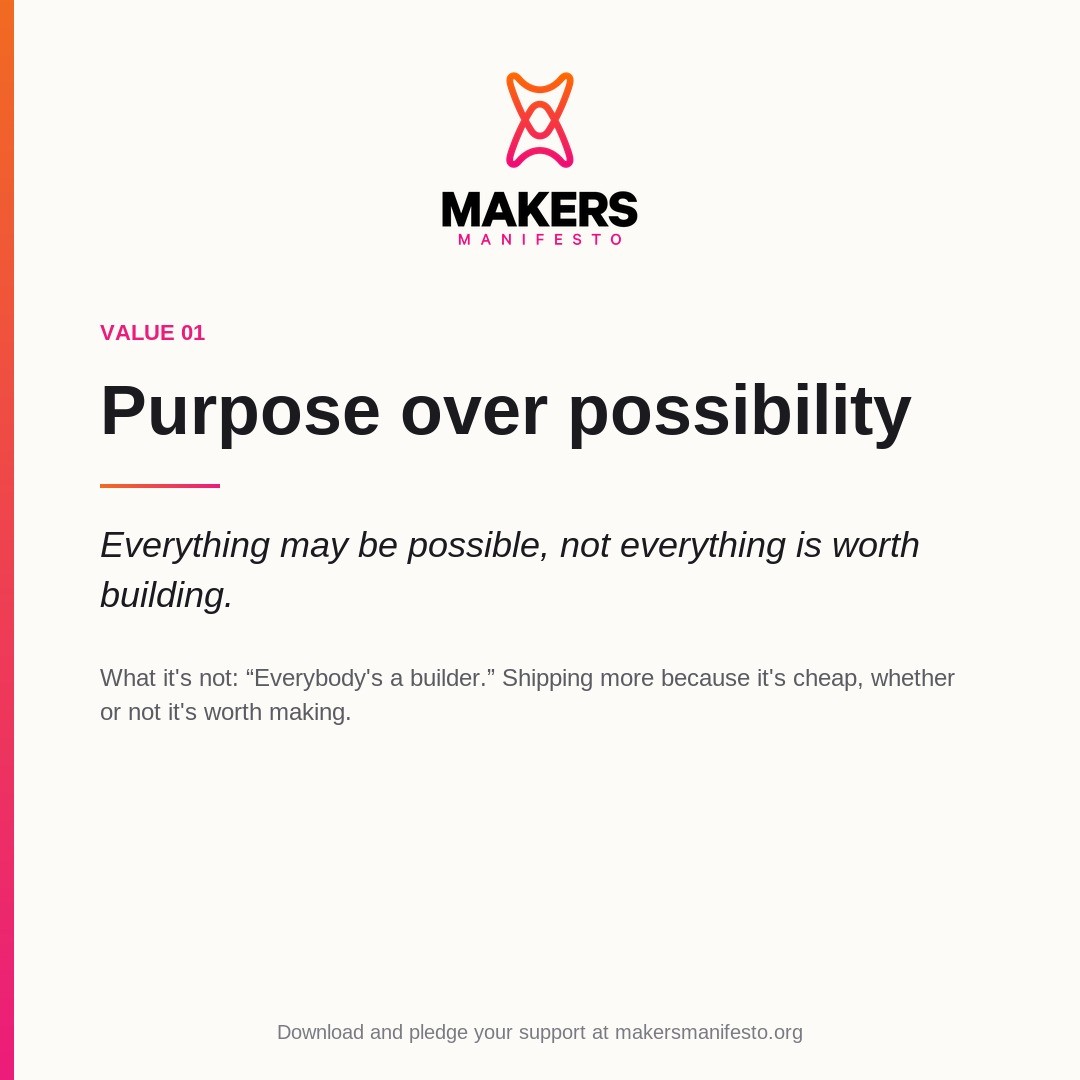
Purpose over possibility. Everything may be possible. Not everything is worth building. AI makes it cheaper and faster to ship things. That doesn't mean you should. The discipline of asking "why this, why now" has never been more important, and it's never been under more pressure.
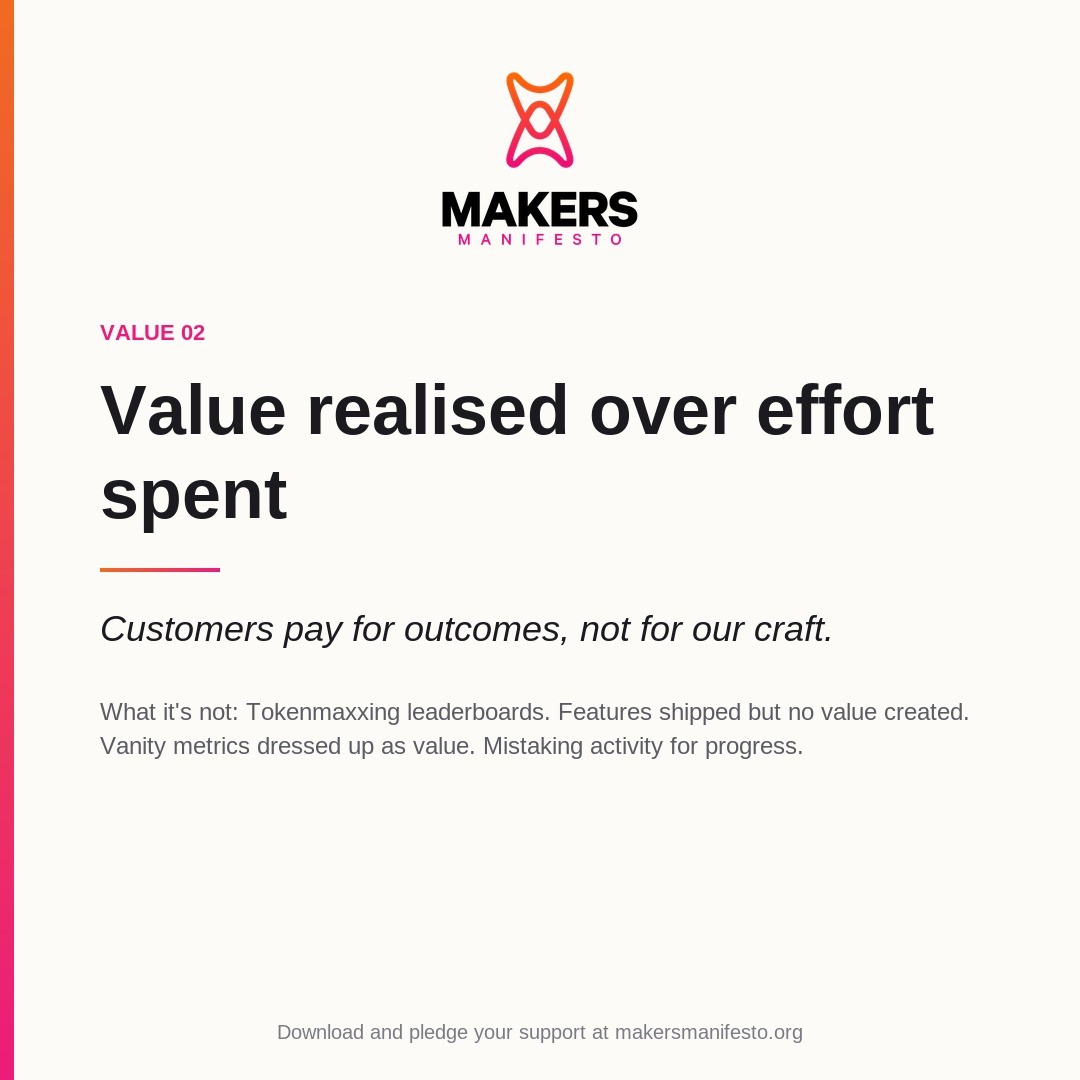
Value realised over effort spent. Customers pay for outcomes, not for your craft. This one hits close to home for anyone who has ever worked in a team that shipped features nobody used and then celebrated the velocity. Tokenmaxxing leaderboards. Vanity metrics dressed up as impact. Mistaking activity for progress. All of it is still happening, just faster now.
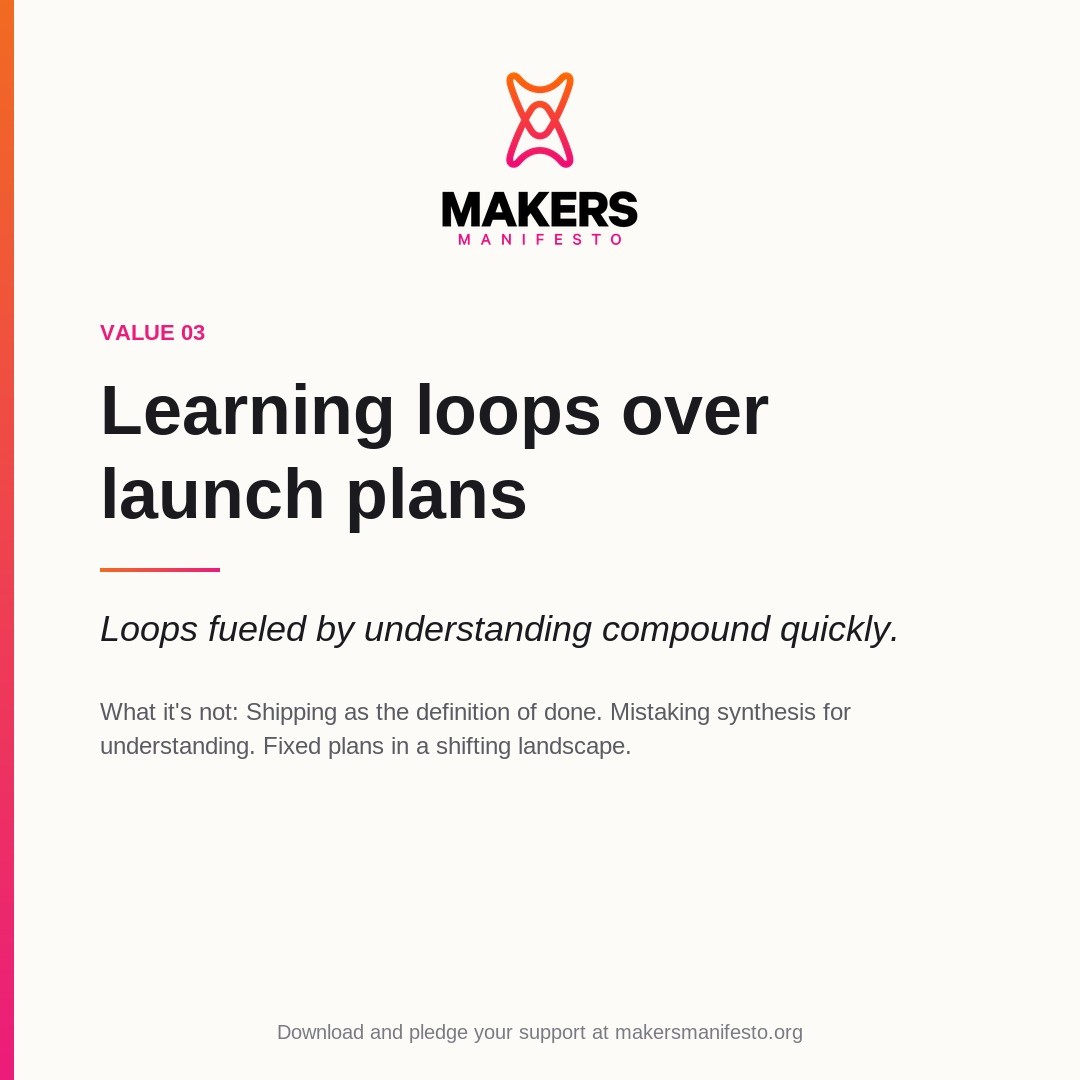
Learning loops over launch plans. Shipping is not the definition of done. Understanding is. Faster building only compounds value if faster learning keeps pace with it. If you're shipping at AI speed but learning at the same old human pace, you're just accumulating confusion more efficiently.
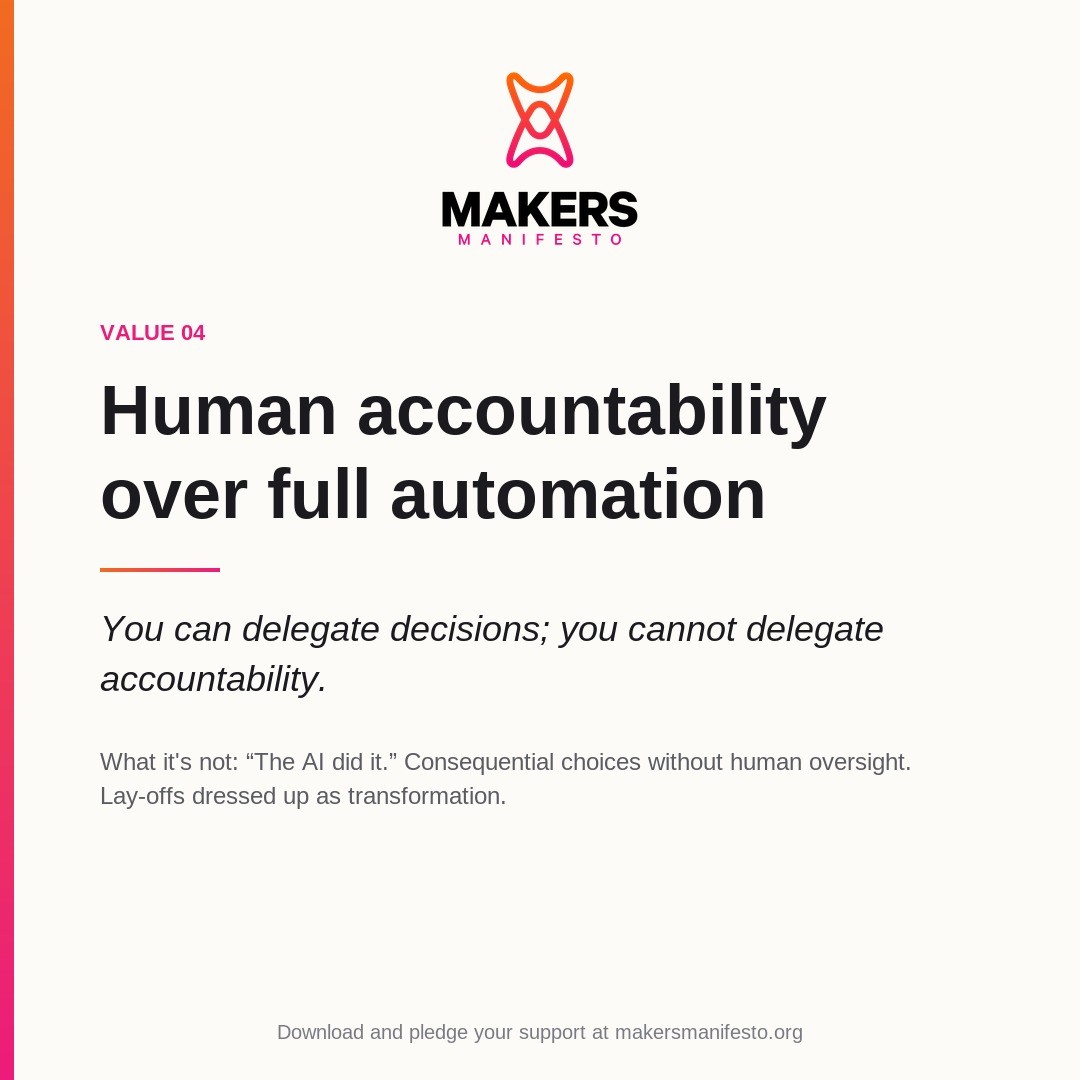
Human accountability over full automation. You can delegate decisions. You cannot delegate accountability. This might be the sharpest value of the four. "The AI did it" is not an answer. Consequential choices without human oversight are not transformation. And laying people off dressed up as progress is not innovation.
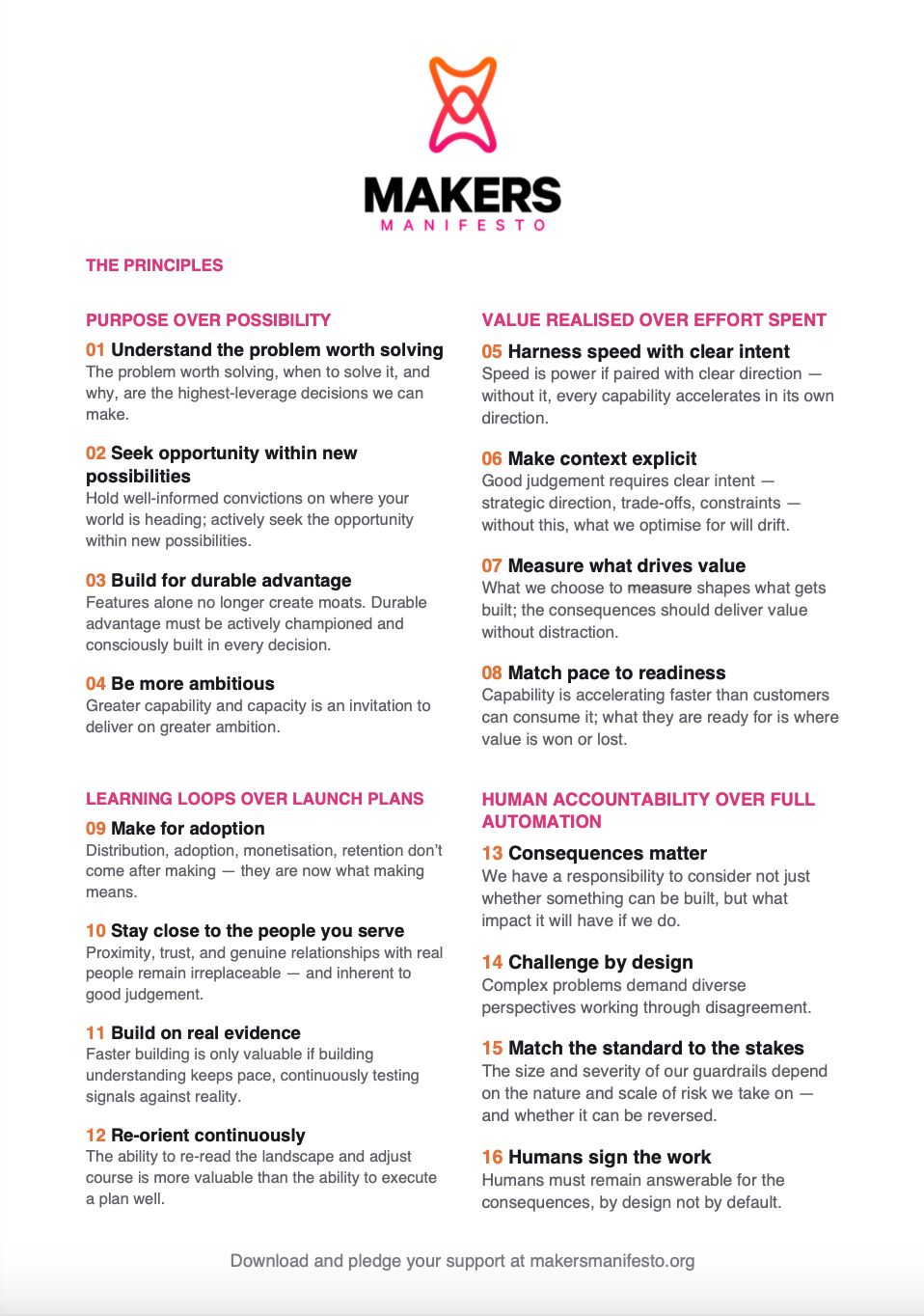
These 16 principles that sit underneath these four values exist to provide grounding in a rapidly changing landscape, both what has shifted and what remains true.
They are worth reading in full at makersmanifesto.org. Each one is specific enough to be useful and broad enough to apply across roles, company sizes, and industries.
Why this, why now
I am genuinely in favour of moving fast. I advocate for releasing early, for running experiments, for throwing more spaghetti at the wall as tracked and measured experiments. That is not the problem. The problem is throwing spaghetti at the wall without thinking, and using AI as the excuse. Because AI makes it trivially easy to ship more, faster, the temptation is to skip the question of whether any of it is worth shipping at all.
The same capacity that lets you move faster also means mistakes scale faster. More spaghetti, sure. But thrown with intent, tested against reality, not just launched into the void because the tooling made it easy.
And there is a darker version of the current moment that worries me more than velocity. Teams that have stopped asking whether they should build something because they're too busy marvelling at the fact that they can. Organisations using AI adoption as cover for decisions they would have had to justify more carefully otherwise. The creeping sense that the question of what humans are for in this process is going quietly unanswered.
The Makers Manifesto doesn't pretend to have all the answers. What it does is name the questions you should keep asking, regardless of what the tools around you are doing. As it puts it:
"Our purpose is to create products customers love, that deliver meaningful gains, shaped by human creativity and technology working together, at a speed matched to the world we now live in."
This aligns directly with the work I do every day. Helping companies become strong product organisations, or adopt the product model, or however you want to call it, is fundamentally about the same things: building with purpose, measuring what matters, staying close to the people you serve, and keeping humans accountable for the outcomes. The Makers Manifesto puts language around principles that product-led organisations either already live by or are trying hard to get to.
How to use this in practice
Read the manifesto and notice where it creates friction. Not discomfort in the abstract, but specific friction: a principle that bumps into something your team does routinely, a value that your organisation's incentives are quietly working against. That friction is the useful part.
Take principle 10: stay close to the people you serve. When did your team last talk to a real user, not read a survey, not review analytics, but actually talk to someone? If you have to think hard to remember, that's your starting point. In your next planning conversation, bring that principle into the room. Ask: are we actually doing this, or are we assuming we are?
Or take principle 07: measure what drives value. Look at the metrics your team reviews every week. Now ask honestly: do those numbers shape what gets built, or do they just get reported? Do you build to move the metric or to change your customer's lives and supporting your business? Can you make decisions based on those or is it just lipsticking? If your metrics aren't changing decisions, they're decoration. The principle isn't asking you to measure more. It's asking you to measure what's worth measuring.
Pick one principle and use it as a lens for a sprint, a quarter, a single decision. One principle applied honestly will teach you more than sixteen principles acknowledged and forgotten.
This is version one, and that's intentional
The manifesto is a living document. The world is moving fast, and the people behind it know that what's right today may need refining tomorrow. That's the point. It's not meant to be handed down from a mountain. It's meant to be used, tested, and challenged.
If you read it and think it's useful, say so. If you read it and think something is missing, or that one of the principles doesn't hold up in your context, that feedback matters too. The worst outcome would be a manifesto that people nod at and then ignore.
Read it. Pledge your support if it resonates. And if you have a reaction to it, whether it's agreement or a genuine challenge, share it. Go to makersmanifesto.org and be part of what comes next.
We are in a moment where staying quiet is itself a choice. I'd rather take a stand.
Further Reading
Other contributors have also written about why they got involved and what the manifesto means to them. Worth reading alongside this:
Antonia Landi, what the Makers Manifesto means for Product Operations: https://www.productopsconfidential.com/p/the-makers-manifesto-and-what-it
Product management insights, delivered to your inbox
Sign up for weekly product insights. No spam.