Deep Dive: Using Impact Mapping in ANY organisational scenario
Stay up to date with the latest insights
I bet after my previous deep dive on Impact Mapping, now you want to implement it. Right?
In that piece, I described my custom approach to this technique and how Impact Mapping helps teams align their work with strategic goals.
If you read it, you know what Impact Mapping is and why it is helpful. But that’s not enough.
So I wrote this new article, detailing how you can use it.
This is a step-by-step guide on how to run an Impact Mapping exercise with three alternatives, each suited to a different organisational context. Whether you’re in a product-driven environment, a feature factory, or somewhere in the messy middle, you’ll find a method that fits.
Why is Impact Mapping such a powerful technique?
Before we dive in, let’s do a quick recap on why Impact Mapping is such a powerful tool.
Any team looking to create alignment benefits from Impact Mapping because:
You can use it at all levels
As a Product Manager, you interact with people at different levels in your organisation. From strategy to operations, part of your role is to align everyone around the same ideas and understandings. Impact Mapping allows you to connect everything, from high-level business goals to the low-level features your team will build.It supports product discovery
Impact Mapping is part of your discovery process, and it integrates really well with other frameworks, like the Opportunity Solution Tree developed by Teresa Torres, the Customer Profile of the Value Proposition Canvas by Alexander Osterwalder, or the Assumptions Mapping by David Bland. You can use it to structure discovery efforts and align your teams on what needs to be tested.It supports conversations with stakeholders
Tell me if you’ve experienced this: in a discussion, stakeholders lead with solutions without disclosing the thought process that took them there. It’s frustrating - I know. But Impact Mapping can help you with it. When you take it as a base to ask key questions, the focus of the conversations shifts from outputs (features) to outcomes (behaviour changes). Slowly, you start seeing a shift to a user-first culture. I call this Reverse Impact Mapping and wrote about it here and here.It informs metrics and driver trees
Try combining Impact Mapping with metrics to create Driver Trees. These will help you measure success and adjust strategies accordingly.It helps you structure your thoughts or the mess in front of you
Whenever you feel lost in your thought process, OR you are trying to make sense of the pile of information in front of you (hello, Backlog that grew wildly and needs a hair cut now), map out the pieces. You’ve found an outcome? Great, put it on paper. Oh here’s an actor! Put it on paper. These paths will help us achieve this goal, those paths help us achieve that goal. Wonderful - re-arrange and draw the lines. Until you’ve mapped the information in your head or in front of you on an Impact Map.
But Impact Mapping isn’t just versatile. It brings real, tangible benefits that teams (and leadership) will actually notice.
It clarifies the why for teams: Your teams gain a clear understanding of why they are working on specific features. The result? More motivation and alignment.
It confirms reasoning for management: Impact Mapping helps managers uncover their assumptions, spot gaps in logic, and align strategic intentions with execution.
It’s visual: A simple, visual representation makes complex ideas easier to understand and keeps everyone on the same page.
Step-by-Step Guide: How to do an Impact Mapping exercise
“Cool, Büşra, I’m in. How do I do it?”
It depends (as everything in Product Management!).
In this case, it depends on where your company is at and, consequently, on where you’ll start. In theory, we should go with the first alternative but, most likely, the second or third scenarios apply to your case - at least based on what I see at the companies I work with.
Alternative 1: The Ideal World Theory
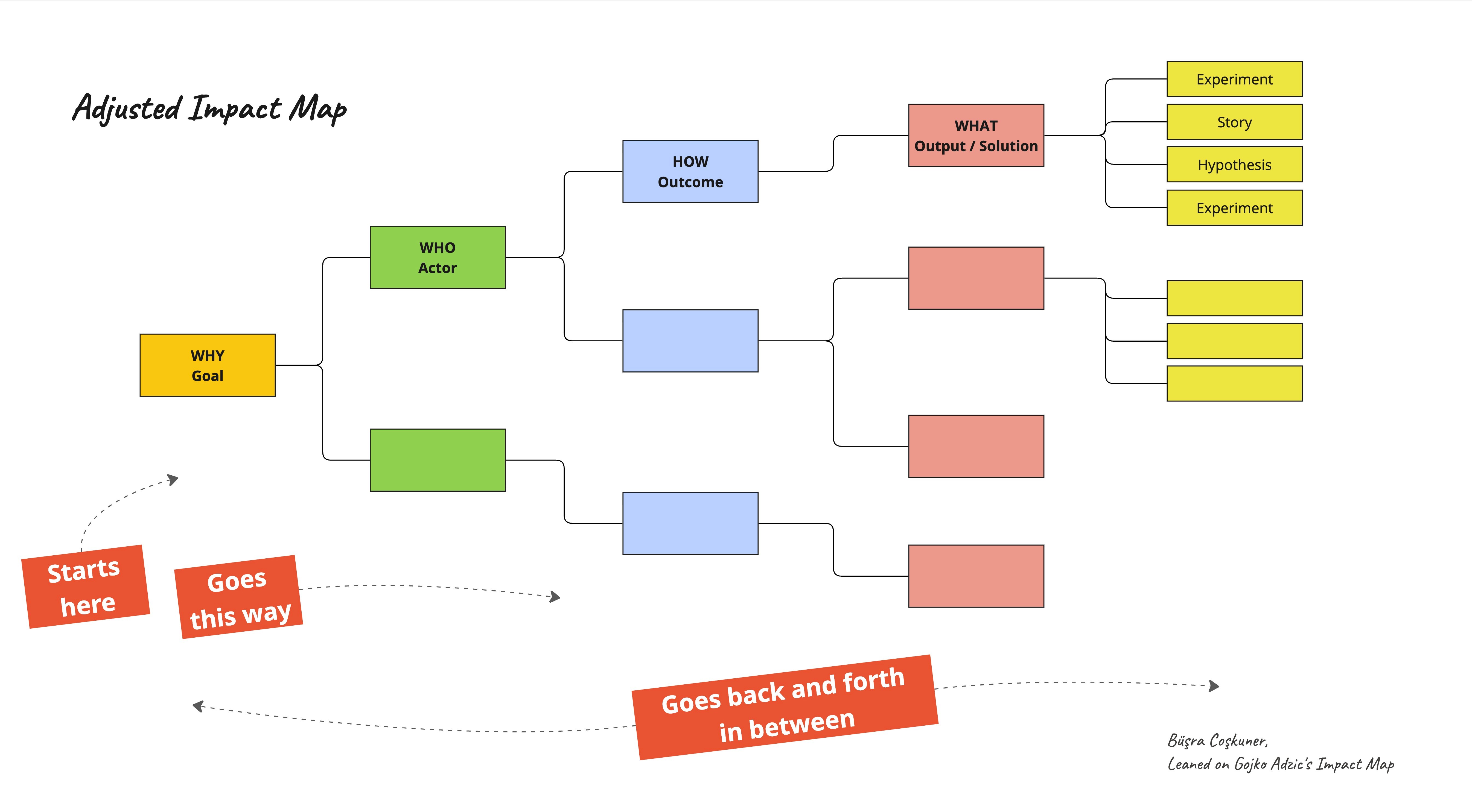
In a perfect world, your company has a SMART goal defined. Let’s imagine it is “decrease time to conversion from 15 to 5 days in the next quarter”. From there, move through these steps:
Identify Key Actors
Ask who can influence that goal (the Actors in the original Impact Mapping framework) and categorise them as primary, secondary, or offstage actors.Focus on Leverage Points
Out of all those actors, pick the three who have the biggest possibility of impacting your goal, either in a positive or negative way.Define Desired Behaviours
For each actor, ask yourself: “What behaviour do we need to see from them to hit our goal?”Cascade into an Outcome Tree
Map these behaviours in an Outcome Tree (this is where the “impact” in Impact Mapping comes from). The tree shows how each actor’s behaviour impacts your business goal.Find the Win-Win
Here’s where I like to add a twist to the standard Impact Mapping exercise. Don’t focus only on what you want from your actors. Instead, ask: “What do THEY want?”
For example, prospective customers might want to know their data is secure or that signing up to your website will genuinely benefit them. You need to look for the win-win that will align their goals with yours. This is a VERY IMPORTANT step you shouldn't skip. Because remember: We want to build products that make our customers happy AND help our business achieve its goals.Move to the Solution Level
Once you’ve identified outcomes, brainstorm features that support them. Some might be simple iterations (e.g.: adding trust badges to your sign-up page), while others could be larger innovations with more uncertainty (e.g.: building a full product demo environment to show value upfront).Decide What to Do Next
Impact Mapping doesn’t end at identifying features. At this point, I recommend the following: for high-importance, low-uncertainty features, move to implementation. For riskier ideas, get data and evidence for making a build vs. reject decision.
🟢 Pro Tip: When you’re done with ideation, use assumption or solution testing. If you’re confident about the concept, test different implementation options. If the concept itself is uncertain, validate the assumptions behind the concept before investing heavily into specifications.
We’ve reached the end of the alternative one. But, as I said, don’t be demotivated if this is not possible at your organisation. Actually alternative 1 stays the hypothetical scenario for the majority of the companies out there. You are not alone ;)
So let’s continue with alternative two.
Alternative 2: Reverse Impact Mapping
Reminder: I go into more detail on how to do this here.
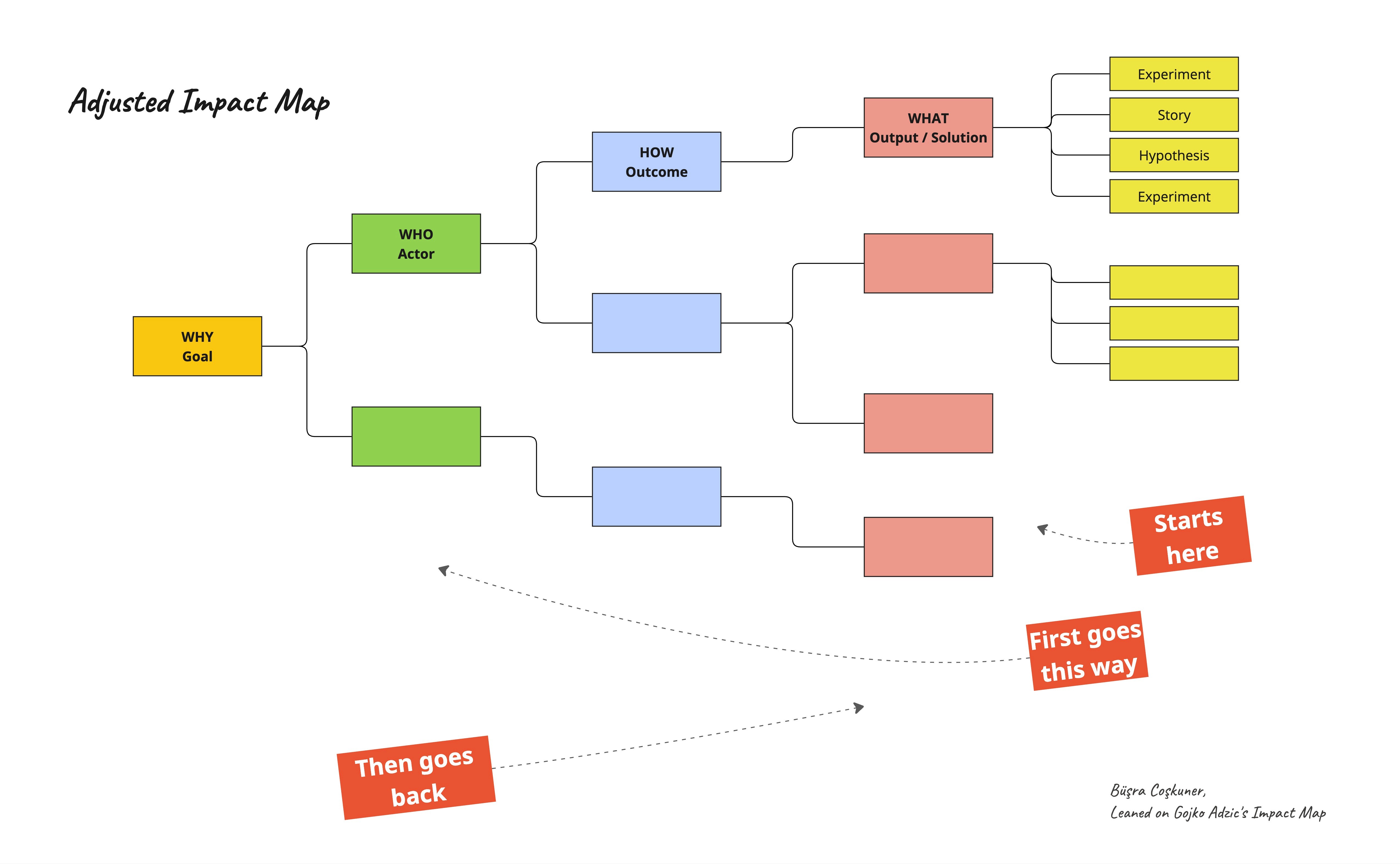
This is the most likely scenario when you work in a feature factory.
We’ve all dealt with top-down directives, starting from the solution and working backwards. If this is your case, here’s how I suggest you approach it: instead of starting with business goals, begin with the feature or idea you've been assigned.
Investigate why it's being requested.
Collaborate with your stakeholders to understand the desired outcome, and suggest alternative solutions.
Here’s an example: stakeholders want to improve conversion rates by adding a new payment method, which would take months. Sometimes this is a good fix. Especially when you are missing main payment methods in your country. But this time you know that the suggestion comes from simply not knowing what else to do and a false belief the next payment method would fix the issue. Instead of just executing, you start asking:
“Where is the biggest drop-off: cart to checkout, or checkout started to completed?”
“Will a new payment method fix this, or are there other friction points?”
Your questions will uncover that the real issue isn’t missing payment options but a confusing checkout flow. So you can propose a quicker fix, like streamlining form fields or adding autofill, rather than waiting months for a complex integration.
This shifts the conversation from “build this feature” to “solve this problem”, helping stakeholders think beyond outputs and focus on real impact. One word of caution: When you start this type of conversation, be kind and humble and phrase your questions kinder than I did here. Stakeholders shouldn't get the feeling that they are questioned. They hate that :)
As your organisation matures and you build trust with stakeholders, you’ll find opportunities to start Impact Mapping from the right place: the business goal.
But some organisations live neither in an ideal world nor in a feature factory. Let’s check alternative three.
Alternative 3: The Messy Middle
Many teams (maybe even the majority) operate in the messy middle.
OKRs guide their focus, but the connection to broader business goals isn’t always clear.
Let’s say your team has a Key Result like “Improve CSAT score by 10%”. This becomes your starting point. Ask: Who are the actors that can influence the CSAT score? And what behaviours do we need to see from them?
See how this is similar to alternative one?
The difference is that instead of starting with a business goal, you work with a more immediate outcome. As you do this, you might realise your OKR is either too broad and might even deserve to act as the goal, or it's disconnected from the actual business goal.
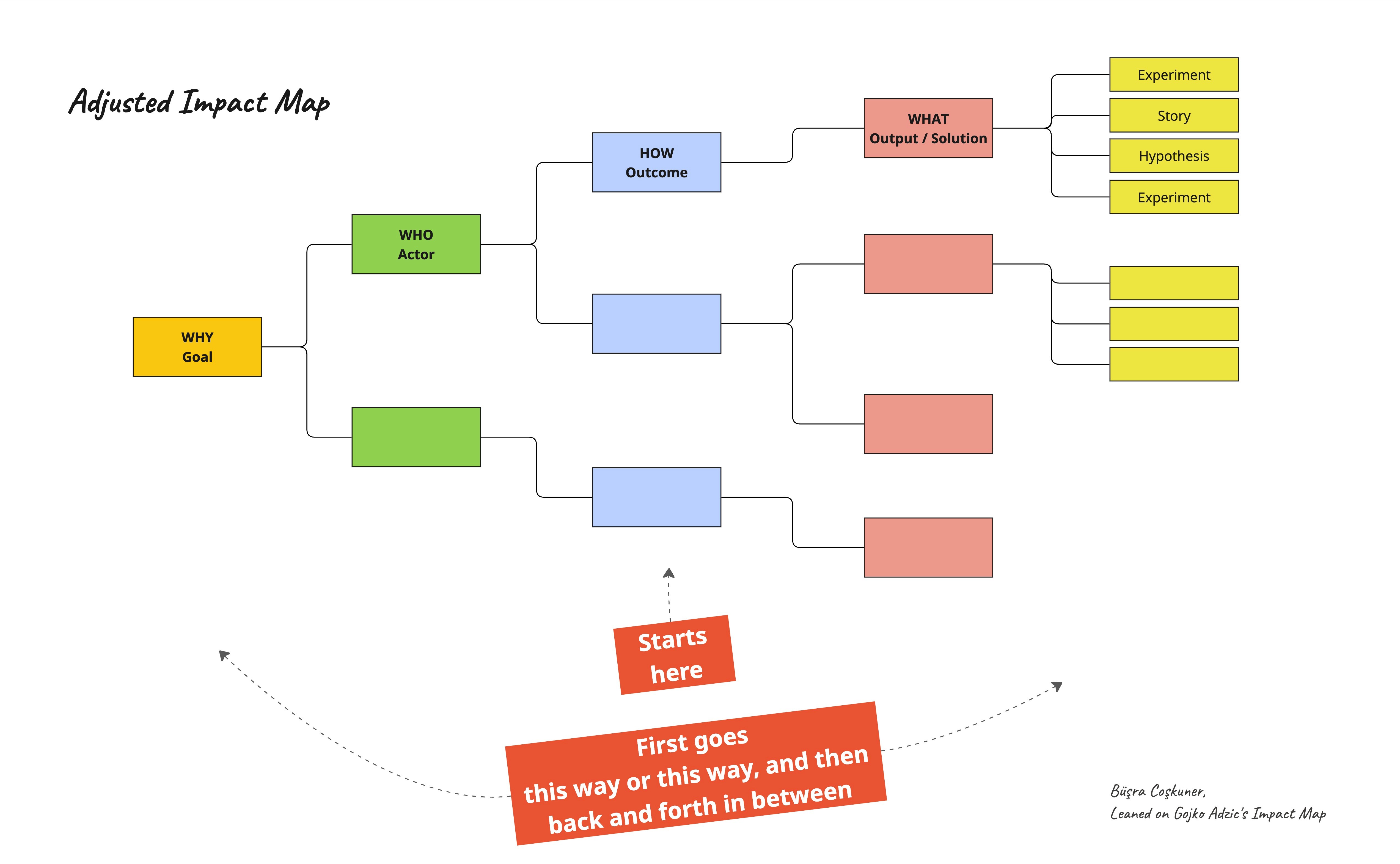
Let me make this clearer with an example from a team I worked with.
Their OKR was focused on boosting sales in a specific segment. But as we mapped it out, we realised that what they had framed as an OKR was actually a business goal and, therefore, too broad to guide day-to-day decision-making.
As a result, the team had to revise their targets, refine their approach, and pinpoint specific behavioural shifts they needed to see in their key customer segments. This clarity helped them define more precise solutions - ones that were measurable, actionable, and better aligned with both the team’s work and the company’s broader strategy.
I’ve seen several variations of this.
In some cases, teams discover their OKR doesn’t align with the company’s priorities. For example, the business goal is to gain new customers, but the team’s OKR focuses on increasing satisfaction for existing customers.
See the disconnection?
In this case, we’d need to revise the OKR to something like “Achieve a CSAT score of X for new customers”. This would realign the team’s efforts with the company’s strategic objectives.
Starting in the middle has its advantages: it helps you clarify objectives, align them with business goals, and ensure your team’s work drives meaningful outcomes. But it’s also a stepping stone.
As you refine your OKRs and establish stronger connections to the company’s strategy, you move your teams from executing tasks to driving strategic impact, bringing you closer to the structured, strategy-to-execution approach of alternative one.
Conclusion
Impact Mapping is a framework - meaning you can and should adapt it to your context.
Whether you’re in a feature factory, navigating the messy middle, or (lucky you!) in a product-driven environment, one of the three approaches I’ve outlined should fit your reality. But don’t be afraid to tweak it.
Just remember to always look for the win-win.
That’s what connects what your business wants to what your users need. It’s the most effective way to ensure every feature or initiative moves the needle in the right direction.
But let’s be honest.
Doing an Impact Mapping exercise on your own can be tricky, especially when you don’t have much experience. If you find yourself stuck or unsure about how to adapt it to your team’s reality, I’ve worked with dozens of teams through this process.
Feel free to reach out if you’d like support in making Impact Mapping work for you.
—
This article was edited by Diana Bernardo.
Product management insights, delivered to your inbox
Sign up for weekly product insights. No spam.