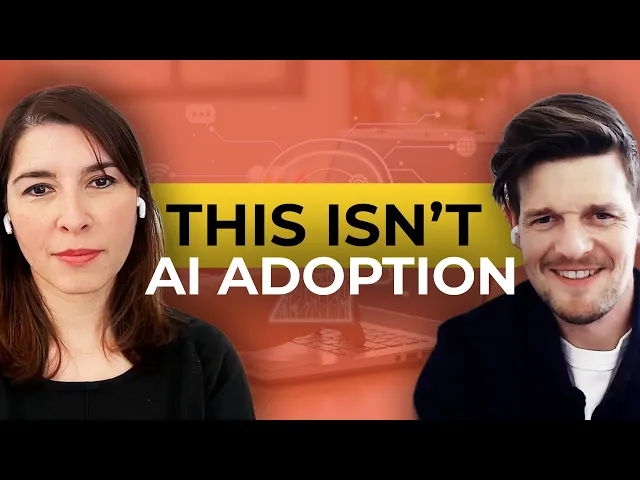
Permission to try: How Instaffo let AI grow from the bottom up
Stay up to date with the latest insights
This article is an in-depth summary (I know, ironic) of an interview with Jan Werner, Lead Product Manager at Instaffo. You can watch the full interview on YouTube.
Enjoy, and as always: Reach out with your thoughts, questions, comments.
—
In the previous newsletter, I shared Ablefy's AI adoption story: a controlled experiment that led to impressive results.
Today’s story is very different from that.
I sat down for a talk with Jan Werner, lead product manager at Instaffo, a German recruitment marketplace. When he joined the company two years ago, AI adoption was already underway. But it wasn’t mandated from the top down - people had spontaneously started adopting new tools like ChatGPT and Cursor, and leadership's response was to encourage it rather than restrict it.
There was no plan, no roadmap, or structured rollout. Just a company figuring things out as it goes. And that’s probably more familiar to most of us.
AI Adoption was a grassroots movement
AI adoption started with people trying to solve their own problems.
Engineers began experimenting with Cursor. Jan built a custom GPT to handle German user copy, a task he'd always found painful and time-consuming. People shared their learnings over lunch. There was no coordination, but soon most of the company was using AI in one way or another.
The official infrastructure came later, mostly as a reaction to what was already happening. When everyone had their own subscriptions, the finance department realised it was more efficient to consolidate everything into Langdock, a platform that gives the whole team access to multiple AI models under one subscription, hosted in Europe.
One deliberate decision has been to avoid relying too heavily on a single provider and remain LLM-agnostic. That makes them more agile and, as Jan pointed out, switching costs are lower than people assume: agents are mostly instructions that you can copy-paste across LLMs. You lose the conversation memory, but the agent moves with you. That's very different from being locked into a SaaS product.
The same pattern of grassroots adoption followed by rollout repeated with Claude Code: people started using it on their own, and it's now in the process of becoming the new company standard.
What changed because of AI
The clearest before-and-after Jan described had nothing to do with what you expect from AI: shipping speed, team size, or process changes. The biggest change was about data.
Before, if Jan needed to answer a data question, he'd write a ticket, hand it to a data analyst, follow up a few days later, and wait. Sometimes, for as long as a week. They work in three-month OKR cycles where decisions need to happen fast, and the waiting period was too long.
So they created a data analytics agent with access to all the company context, such as data tables, full documentation, and Instaffo’s core KPIs.
Now, when Jan or any other PM needs to query the data, they can do it themselves in a matter of minutes. Jan gave a concrete example: asking the agent about application-to-interview conversion rates between two groups, a key metric in Instaffo's funnel. The agent doesn't just return a SQL query. It runs the query, shows the graphs, and adds a short analysis. And because Instaffo has a sophisticated KPI tree where every metric connects to a hire (and every additional interview can be translated into an expected revenue figure), the agent can help PMs connect product decisions all the way up to business outcomes.
It speeds up PM work and frees data analysts to focus on higher-impact tasks.
The other noticeable change AI created was related to documentation.
Most PMs have experienced the pain of spending way too much time on writing everything down: tickets, PRDs, meeting notes. With AI now part of every meeting (recording, transcribing, and summarizing), the time humans need to put into writing has shrunk.
“Refinement is on Wednesday, so I used to take every Tuesday off just to write tickets”, Jan said.
With AI holding more context, less information needs to be manually transferred between people. Less handover, less writing. And even when writing is required, it’s not the same anymore: instead of typing, Jan now dictates most of his content. His voice-to-text assistant has logged as many as 136k words so far, roughly the equivalent of two novels!
The new way of working
Instaffo’s working setup is based on product trios: a PM, a designer, and a tech lead, operating in 3-month OKR cycles.
AI hasn’t changed that. They still approach the beginning of a cycle in the same way: coming together, setting goals, running user interviews, working through Opportunity Solution Trees.
What has changed is everything around that core.
Every discovery meeting is now recorded, summarised, and added to a shared project folder for the cycle. They've built a repository of opportunities that Jan described as “knowing more than the Miro board.” The context doesn't get lost anymore, it adds up.
They're also building an agent specifically for the OKR cycle, loaded with learnings from previous cycles, A/B test results, and company goals. The idea is that the agent holds the context so the team doesn't have to.
As with other companies, roles are evolving in ways that would have seemed unlikely a couple of years ago:
PMs are writing and shipping code: Jan uses Claude Code to write simple code. For example, they needed tracking code for a feature, so he wrote it with the help of Claude Code, something that previously would have required an engineer. Some issues are now small enough that the team tags them as "vibecodable," meaning a non-engineer can pick them up and ship them without much overhead. Jan was clear about the limits of this, though: “You can ship code without coding, but you can't ship the complex stuff.”
Designers are prototyping before committing to high-fidelity: Before investing time in detailed Figma designs, the team now uses Figma Make to build quick prototypes. Because it has access to the component library, it already knows exactly how elements look, so the prototypes come out looking great. Jan mentioned they've taken these prototypes directly into user interviews, and sometimes had to explain to participants that what they were looking at wasn't the finished product.
Designers are shipping their own components: Designers can now access information about the existing app directly, such as fields, how many inputs the user actually has to give, what's already been implemented… context they previously had to collect the hard way by asking engineers and PMs. Also, some designers are now going beyond prototyping and pushing their own components to production. As Jan said, “I would expect more from designers than just do design."
The new bottlenecks
The biggest bottleneck AI introduced to Instaffo was code review.
The company ran an internal AI adoption survey with developers and realised the biggest increase in AI usage over the last six months wasn't in writing code: it was in reviewing it. That sounds positive until you hear how the engineers react to non-engineers contributing code:
"Why should I review your slop AI code? What's my incentive?"
It’s a tension the company hasn’t fully resolved yet. Part of the resistance comes from how bad early AI-generated code was, and that impression stuck. Jan's view is that as output quality improves, acceptance will follow, but he acknowledged that fear is part of what's driving the pushback, and it’s not going away quickly.
The other new bottleneck is QA capacity.
Shipping faster led to issues piling up. The initial response was to wait and maintain quality. But Instaffo is already looking at whether an agent can help - one that opens the page, makes screenshots, clicks through buttons, and analyses what's not working, essentially doing the interface-level QA that doesn't require understanding the underlying code.
For minor changes where the code owner has already signed off, they’re also considering allowing merging without full QA approval. Neither solution is in place yet, but both are on the table.
Measuring something that's hard to measure
Jan was candid that there's no single KPI tracking AI adoption across the company.
Different functions measure different things. For engineers, it's the percentage of code generated with AI assistance. For others, it's softer indicators, like surveys asking how useful AI is in day-to-day work, or simply observing that time to output has decreased.
Measurements are also tricky because AI is getting embedded into everything: tools are adding AI features that improve productivity without anyone intentionally deciding to adopt anything. So the question of how much of the improvement is due to deliberate AI adoption is hard to answer.
In Jan's words: “you could put a number on it, but that number would be lying to you a little.”
Jan’s advice
Jan's biggest piece of advice to anyone wanting to explore AI in their workflows: don't overthink it. No one will hand you a roadmap. Just start, and figure it out as you go.
For companies: let people try things. Don’t lock them out of tools. Give them basic security guardrails: make sure settings aren't set to train the model, know what company data you're putting in, and whether it needs to be anonymised, for example. And then get out of the way.
Nobody designed the adoption journey at Instaffo. Someone tried something. Then someone else did. Eventually, it spread. If you want to go deeper and learn more about their story, reach out to Jan on LinkedIn.
What I’m taking away
There are two camps in the AI conversation right now: the people who think it will change everything, and the people who think the fundamentals still matter most. I keep coming back to the idea that the truth sits in the middle, and Jan's experience is a good illustration of why.
The fundamentals haven't changed. Cross-functional collaboration, user empathy, finding strategic opportunities, working towards problem-solution-fit and product-market-fit, making informed decisions… none of that went away. What changed is everything around it.
Jan said nobody will hand you a roadmap. I won't either. But this series is my attempt at something close: real stories from companies figuring it out, so you don't have to figure it out alone. Because most companies are precisely in this messy middle, trying to figure things out, often feeling like they're behind.
If that's you, you're exactly who this series is for.
—
This article was edited by Diana Bernardo.
The video was edited by Connor Clayton's team at Precision Edits.
Product management insights, delivered to your inbox
Sign up for weekly product insights. No spam.