Product Manager skills in the AI era: sharpen one, learn one, pick one extra
Stay up to date with the latest insights
When AI does the writing, the legwork and the automation, Product Managers are no longer measured by the work they get done. Fresh from the Compass AI & Tech Summit in Budapest, here is my take on what's left for humans: sharpen your human skills, start building, and pick one extra to double down on.
—
I just came back from the Compass AI & Tech Summit in Budapest. The impression that I left with was: AI is not the future, it's here and now, and we're actively shaping it.
This is nothing new you'd say. The point that is new is: by now we've understood how to get the basics of the technology into our companies, and now we're fine tuning in three ways:
Technical fine tuning of the agentic system.
Moving our focus from output to impact with AI.
What's left for humans.
I was involved in the conference in three ways. I ran my Success Metrics With and Without AI workshop. Joined a Panel at the Tech Leaders Forum on the topic "How should engineering operate when everyone can build". And held my new talk "10x the output. Where's the impact?! 5 principles of meaningful AI adoption".
So you can see I have an opinion on the topics 2 and 3.
This article is about number 3: What's left for humans.
What's your "extra"?
Already two years ago, I stood on the stage of the Craft Conference and had three predictions on how AI is going to change our world and what's important for engineers to stay relevant. I might write an article about my predictions, and how 2 of my 3 hypotheses became true.
This year, I noticed that my tips for engineers are as relevant for Product Managers.
In times when AI can do the leg work, do the writing and the workflow automation, Product Managers are not measured by the work they get done. The focus shifts to the value that their work creates, and what their work becomes.
I see 1 important skill for Product Managers to sharpen, 1 to learn and 2 potential extras.
Relevant skills in the AI world
Human skills
At the panel discussion, we panelists agreed on one major point: whether you're an engineer or a product manager, sharpen your human skills.
My co-panelists were Mirela Mus, Founder & CPO at Product People, and Jeremy Brown, CTO at GitGuardian. The wonderful hosts Péter Szász and Emese Pogácsás joined the discussion. We all agreed, that now that we can build so fast with AI, we need to put more emphasis on the human side of the work.
For Product Managers concretely, I ask you: Who will take the stakeholders along? Who will align them on the direction? Who negotiates and keeps nerves calm?
The human. Not the AI.
This part of the work is not going away. Relationship building, communication, alignment, collaboration. "Be easy to work with" was mentioned, too, by Mirela Mus. I understand that it's difficult to apply because what's the definition of "being easy to work with". Sounds scary. She gave very good examples like "Don't just say 'no' but push back with questions like 'how will this help us achieve our goals' or 'what else should we drop'."
So, point number one: sharpen your human skills.
Start building.
Here I will give you the exact advice that I give my Product Manager friends. Many product coach friends will hate me when I say this but it's the new reality: companies expect product managers to build. Building doesn't necessarily mean production ready code, it can mean building prototypes to sharpen your thoughts or for discovery reasons. But you need to be able to use AI to build. So in my talk I said: "Start building!"
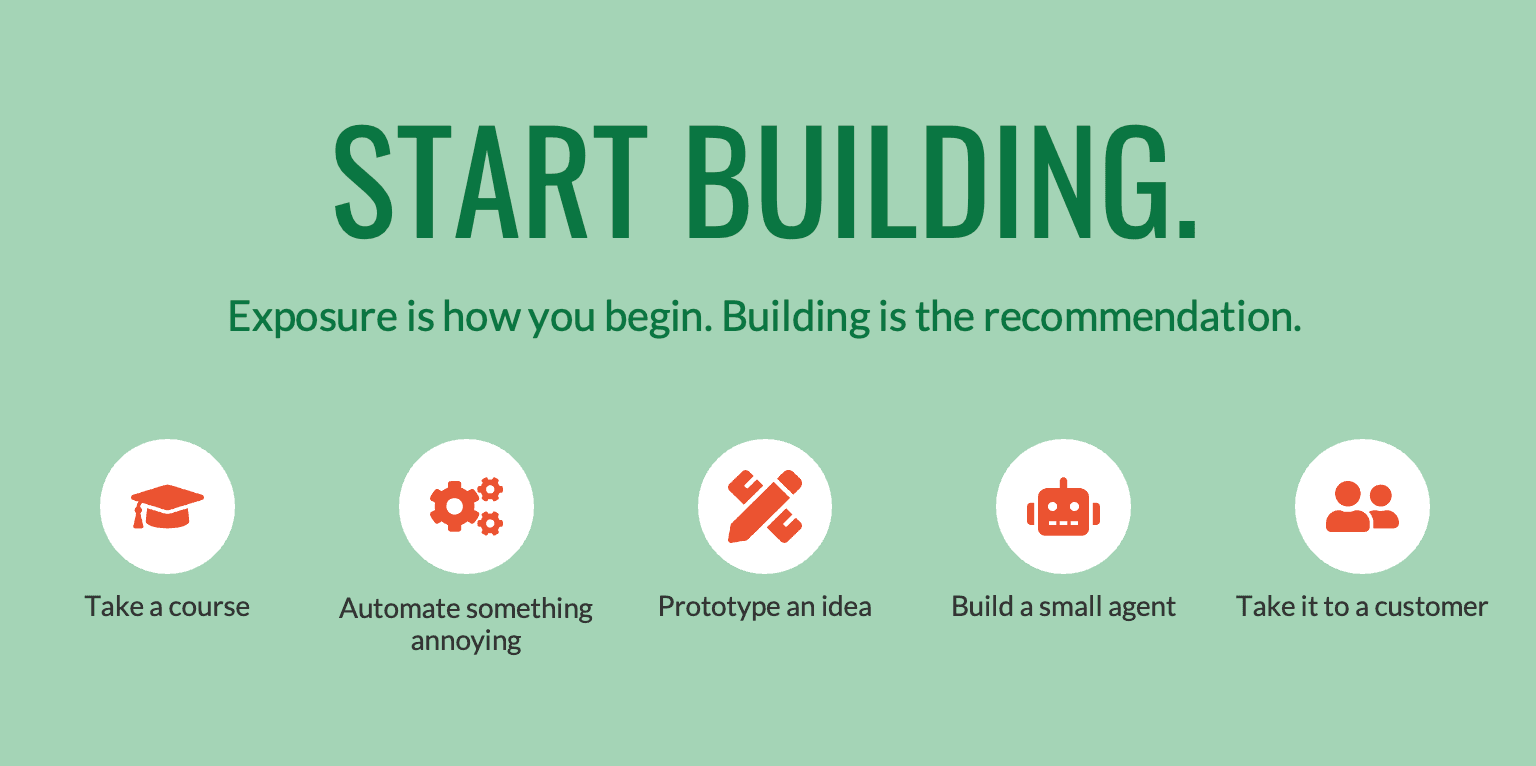
Source: Büşra Coşkuner, Slide from talk "10x the output. Where's the Impact?! 5 principles of meaningful AI adoption"
I don't sell anything in this direction, so my recommendation is not because I earn money from it. It is because I see what's happening in the market. A couple of weeks ago at another conference, a CPTO said "I build, too. Of course I expect every product manager to build, junior or senior. The seniors will spend less time on it than the juniors but everybody needs to be able to build." And this was the CPTO of a B2B company in a conservative industry with not tech-savvy users, not a hyper-scaler.
Point two: Turn ideas into something tangible with AI.
Two potential extras
We see it more and more in job ads and hear it more and more in interview processes that two knowledge areas become more and more important.

Source: Büşra Coşkuner, Slide from talk "10x the output. Where's the Impact?! 5 principles of meaningful AI adoption"
One: Become more business-savvy. In an era when we can create 10x output, it's easy to build everything "we want" without knowing if it has any impact on our customers and our business. Considering that tokens cost a lot as well and the economics of building, running and maintaining software is changing with AI as infrastructure, tool and basis for some of our features, you need to be able to show the business impact of your idea.
Become more strategic, learn how to build business cases (I recommend you to reach out to Simonetta Batteiger or Rich Mironov for that - I don't get commission), learn to connect your work with business outcomes (ask me for my Impact Mapping workshop), read a P&L, learn about pricing and positioning to become good buddies of GTM teams…
Two: Domain expertise. How do you want to judge your AI's answers well if you don't know what good looks like? One arm of that is being very good at your craft and having critical thinking. The other arm of that is having deeper knowledge about specific dynamics in an industry or function.
You can double down on your industry expertise, like FinTech, EdTech, Marketplaces etc. or on your functional expertise, like payments, PLG, search, etc.
Point three: Pick one extra that you want to be very good at and add it to your human and building skills.
"I'm overwhelmed"
Honestly, I feel that overwhelm, too. I don't think you should try to be good at all of the above. That's a direct way to burnout. Don't do that.
I am rather saying:
Human skills are important for Product Managers anyway, and it's becoming more important.
Building is not going away, learn to create something tangible with AI. In general, become a bit more technical. Don't become an engineer. Otherwise you'd be an engineer - obviously.
Pick something that you're already good at and double down on that. It could be domain expertise, or your commercial and strategic thinking.
At some point in the future, we all will be building in some way - that's my hypothesis. And I'd better be prepared and have fun on the way getting there than closing my ears and hoping this "hype" will go away. It's not a hype.
But I also believe that there will still be a lot of companies in the transition phase where you will not have to be building yet, or that don't look for domain experts or strategic thinkers. And I'm sure there will still be dinosaurs in the future that will mainly operate the same as they do today. So, don't worry, you'll have a place.
And if you want me to give my talk "10x the output. Where's the impact?! 5 principles of meaningful AI adoption" at your company or conference, reach out. I will soon write more about the 5 principles.
Product management insights, delivered to your inbox
Sign up for weekly product insights. No spam.